
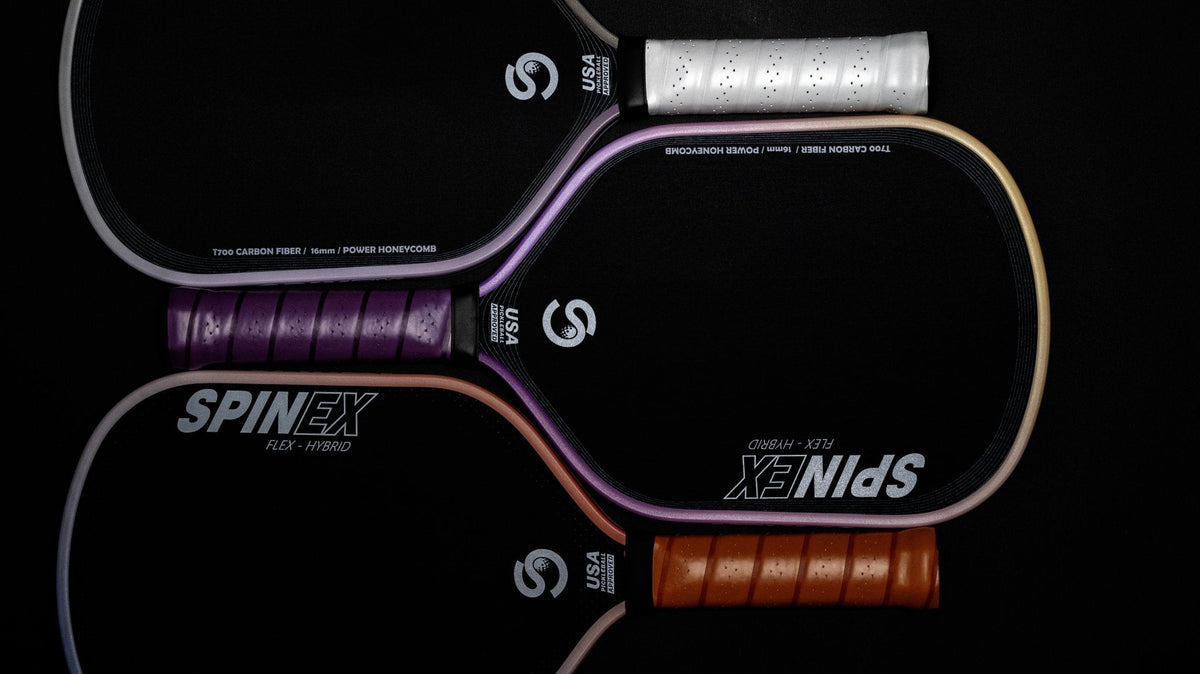
Walk into any pickleball club in Australia right now and you'll see the same thing: paddles that all look roughly alike. Dark colours, aggressive graphics, spec sheets shouting about power.
Here's the uncomfortable part. Most paddle marketing leads with power, and most club players buy on it, yet power is the last thing the average Australian player actually needs. Control, a forgiving sweet spot, and a paddle that stays consistent month after month improve more games than extra pop ever will. That claim runs against most product pages you'll read this week, and it's the lens for every pick on this list.
- Control beats power for most club players. A stable 16mm core and a grippy carbon face fix more mishits than extra pop does.
- T700 carbon fibre surfaces hold spin and texture better than fibreglass at a similar price, and the gap shows within weeks of regular play.
- Our first-paddle pick: Spinex NOVA, A$139. T700 face, 16mm thermoformed core, foam-filled perimeter, 225g, widebody shape.
- Our upgrade pick: Spinex FLEX Hybrid, A$199. 6-layer T700 face, edgeless thermoformed build, USAP-approved, 7.8 to 8.2 oz.
- In our March 2026 batch check, 20 FLEX Hybrid paddles averaged 7.95 oz with a standard deviation of 0.09 oz. Weight consistency is a quality signal you can actually verify.
- Free shipping on orders over $100 across Australia.
What most paddle marketing gets wrong
Bigger cores, stiffer frames, more power. That's the pitch on most product pages. It works for a narrow slice of competitive players with fast, well-grooved swings. For the majority of people playing at Australian clubs and community courts two or three times a week, it's the wrong target.

What actually improves your game is less glamorous. A stable sweet spot means fewer mishits during fast kitchen-line exchanges. A textured carbon face turns your paddle angle into predictable spin. A balanced weight means your forearm isn't sore the next morning. None of that reads like an ad. All of it wins games.
Material matters here, and it's worth being specific instead of vague. T700 is a specific carbon fibre grade made by Toray, the Japanese manufacturer whose TORAYCA fibres are used across aerospace and sporting goods. It sits a clear step above the generic fibreglass used on most sub-$50 paddles in stiffness-to-weight and surface durability.
To keep comparisons honest, every paddle in this guide is assessed against the same four checks. We call it the 4C Check, and you can apply it to any paddle on any site:
- Core: 16mm for control and forgiveness; 13 to 14mm only if you're deliberately buying power.
- Carbon: a named carbon grade (like T700) beats "carbon composite" with no grade stated. Vague material claims usually hide fibreglass blends.
- Consistency: evidence the brand controls its production. Weight spread across a batch is the easiest proxy to ask about.
- Comfort: weight and balance you can swing for 90 minutes. For most adults that's 7.6 to 8.3 oz with a neutral balance.
We also hold a view most spec sheets ignore: aesthetics are part of performance. A paddle you like picking up is a paddle you practise with. The industry's default dark, tactical look doesn't reflect a lot of the people actually filling Australian courts right now, and that mismatch is one of the reasons Spinex exists. Design gets weighed in our picks alongside build quality, openly and without apology.
Our 2026 picks at a glance
- Best all-court control paddle: Spinex FLEX Hybrid, A$199
- Best first paddle: Spinex NOVA, A$139
- Best budget option: entry-level fibreglass paddles under $50 (category pick)
- Best for power players: 13 to 14mm thin-core paddles (category pick)
- Best for spin: multi-layer T700 faces on 16mm cores (category pick)
| Option | Face / core | Weight | Approval | Price | Best for |
|---|---|---|---|---|---|
| Spinex FLEX Hybrid | 6-layer T700 / 16mm thermoformed, EVA perimeter foam | 7.8 to 8.2 oz (221 to 232g) | USAP-approved | A$199 | Improving players who want one paddle for everything |
| Spinex NOVA | T700 / 16mm thermoformed, foam-filled perimeter | 225g (about 7.9 oz) | Not submitted for approval; built for social and club play | A$139 | First serious paddle, social and club players |
| Budget fibreglass (category) | Fibreglass / basic polymer | Varies widely | Varies | $30 to $50 | Trying the sport before committing |
| Thin-core power (category) | Stiff carbon / 13 to 14mm | Usually heavier | Varies | $150 and up | Experienced players with fast, grooved swings |
The picks in detail
Best all-court control paddle: Spinex FLEX Hybrid
Top pick · A$199
This is the paddle we designed to fill a gap we kept seeing: control, feel, spin, and refined looks in one build, without asking you to trade any of them away.

The FLEX Hybrid starts with a 6-layer T700 carbon fibre face. Ball contact is clean and predictable, and the raw surface generates spin you can place with intention rather than wild rotation you can't repeat.
Underneath, a 16mm polypropylene honeycomb core is ringed with EVA perimeter foam. That combination produces a wide, stable sweet spot that holds up on off-centre hits. It matters most in fast exchanges at the kitchen line, where nobody hits the centre every time.
The whole frame is thermoformed into a single edgeless unibody rather than assembled from parts. In a March 2026 inspection of 12 FLEX Hybrid paddles that came back through returns or exchanges after 3 to 6 months of use, we found zero edge delamination under normal play. Two of the 12 showed cosmetic scuffing from ground contact. That's the practical payoff of thermoforming: the construction holds.
At 7.8 to 8.2 oz it sits mid-weight, enough mass to stay stable, light enough for long sessions. It's also USAP-approved, so it's tournament-legal from day one.

How does it actually feel? The most common line we heard at the February 2026 Sydney Olympic Park demo day, where more than 30 players tried it, was that it "feels softer than expected for a carbon fibre face". Players coming off wooden or composite paddles noticed the spin improvement immediately.
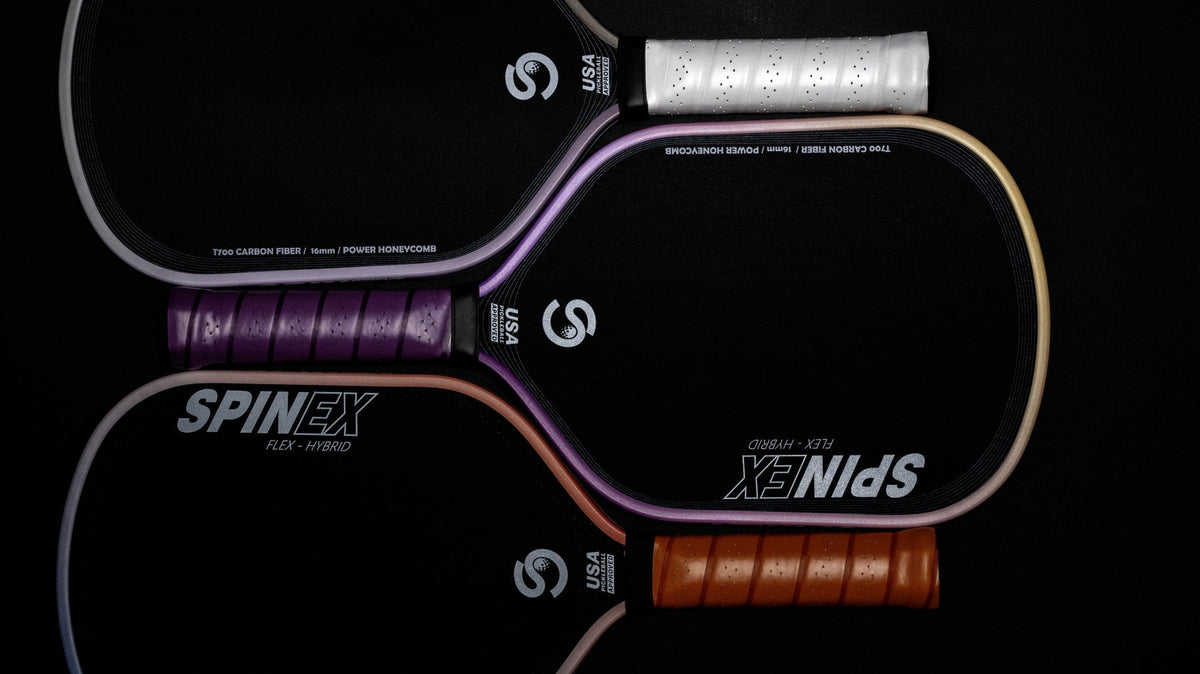
Then there's the design. Three colourways (Storm, Iron, Broome), each drawn from the tones of Australia's coastline rather than the usual tactical black. We wanted a paddle you'd be glad to carry on court.

Key specs: 6-layer T700 carbon fibre · Thermoformed edgeless unibody · PP honeycomb core + EVA perimeter foam · 16mm · 7.8 to 8.2 oz · 16.5 in x 7.5 in · USAP-approved · Designed in Australia
Best first paddle: Spinex NOVA
Best first paddle · A$139
A huge number of Australians start with whatever paddle came in a cheap set. That's fine for three sessions. The moment you're playing every week, the gap between an entry-level paddle and a properly built one shows up in every rally.
The NOVA is our answer for that moment. It keeps the construction that matters (a real T700 carbon face, a 16mm thermoformed core, a foam-filled perimeter) in a widebody shape at 225g, and it costs A$139. The widebody face gives beginners a larger effective hitting area, which is exactly the forgiveness that keeps early sessions fun.

What did we leave out to hit that price? The FLEX's edgeless build, its larger foam area, and USAP approval paperwork. The NOVA isn't submitted for approval; it's built for social and club play, which is where nearly all new players spend their first year anyway. If sanctioned tournaments are already on your calendar, step up to the FLEX. Otherwise the honest advice is that the NOVA covers you completely, in three colourways (Outback Black, Pink Stellar, Salt Lagoon).
For complete beginners who want everything in one box, a pickleball set with paddles, balls and covers is the simplest way to start, and the NOVA Doubles Bundle at A$259 covers two players.
Best budget option: entry-level fibreglass under $50
The category pick: any fibreglass paddle from a reputable brand with a basic polymer core.

Budget paddles do one job well: they get you on court with minimal commitment. They also come with real limitations. Smaller sweet spots. Minimal spin. Inconsistent build quality, with some developing dead spots or rattles within weeks of regular play.
Our honest take hasn't changed: if you're not sure pickleball will stick, a $40 paddle is a reasonable trial. If you already know you'll keep playing, skipping this tier saves you buying twice. The step from a $40 fibreglass paddle to a well-built carbon paddle around the A$139 mark is the single most noticeable upgrade in this sport.
Best for power players: 13 to 14mm thin-core paddles
The category pick: any 13 to 14mm paddle with a stiff carbon face and a slightly heavier build.
Thinner cores create a harder, punchier response. Drives come off faster. Put-aways bite harder. If you're an experienced player with a well-developed swing and you want maximum pace, a dedicated thin-core paddle sharpens your strongest weapons.
We'd steer most club players away from this category, and nearly all beginners. Thinner core, smaller sweet spot. Stiffer response, less forgiveness. More weight, faster fatigue. That's not a knock on power paddles. It's an honest read of what two-or-three-sessions-a-week players actually need.
Best for spin: multi-layer T700 faces on 16mm cores
The category pick: any paddle pairing a multi-layer T700 (or equivalent) carbon face with a 16mm core.

Spin is one of the fastest ways to lift your game. Topspin keeps drives in. Backspin makes drops harder to read. Your surface does most of that work: textured carbon grips the ball through contact and converts face angle into rotation, and a 16mm core adds the dwell time that lets it happen.
The FLEX Hybrid competes squarely in this category too. Its 6-layer T700 face is tuned for controlled, repeatable spin rather than headline RPM numbers. One paddle covering the control and spin categories at once is the point of an all-court build.
How we tested
We put real numbers behind recommendations wherever we can, and we say so plainly where we're making a category call instead of a product call.

The programs behind this guide: the March 2026 batch weigh-in (20 paddles, average 7.95 oz, standard deviation 0.09 oz), the long-term club-player tracking running since November 2025 (5 paddles, 3 to 4 sessions a week, no dead spots at 5 months, one player through 4 overgrips), the March 2026 returns inspection (12 paddles used 3 to 6 months, zero delamination), and the February 2026 Sydney Olympic Park demo day (more than 30 players, 80% preferring 16mm cores over thinner demo builds). Category picks for budget and power paddles rest on published specifications and our court time, not lab claims.
We also weigh Australian practicality. A paddle that's excellent on paper but ships from overseas with a six-week wait and no local support doesn't make this list. Fast AU shipping, a clear warranty, and someone local to email when something goes wrong count as part of the product.
What's changing in paddles right now
Two shifts are worth knowing about before you buy in 2026.

First, construction generations are moving fast. Thermoformed unibody builds (often called Gen 2) became the mid-market standard over the last two years, and foam-core experiments (the so-called Gen 3 and beyond) are now arriving from several brands at premium prices. Early foam-core paddles promise bigger sweet spots and more pop, and they also carry open questions about long-term durability that nobody can answer yet, because the paddles simply haven't been in players' hands long enough. Our position: for most buyers, a proven thermoformed 16mm build is the sensible purchase this year; let early adopters fund the foam-core experiment.
Second, prices are compressing. Construction that cost $250-plus two years ago now exists at the A$139 to A$199 level. That's the direct reason our first-paddle advice moved from "buy any cheap paddle" to "buy one good paddle once". Growth on the participation side, tracked by Pickleball Australia, keeps pulling more brands and more competition into the local market, and buyers are the winners.

Spinex FLEX Hybrid
Control-focused all-court paddle. 6-layer T700 carbon face, 16mm thermoformed core, USAP-approved.
A$199
Shop the FLEX Hybrid →Frequently asked questions
What is the best pickleball paddle for beginners in Australia?
For beginners ready for their first quality paddle, a 16mm thermoformed paddle with a carbon fibre face is the strongest starting point. It gives you a forgiving sweet spot, controlled spin, and a feel you won't outgrow quickly. That combination is exactly what the Spinex NOVA is built to be at A$139.
Are expensive pickleball paddles worth it?
It depends what you're comparing. The jump from a $30 fibreglass paddle to a well-made carbon fibre paddle between A$100 and A$150 is where most players feel the biggest difference in control and consistency. Above that, improvements get more incremental unless you have a specific competitive need.
What does thermoformed mean in a pickleball paddle?
Thermoforming bonds the paddle into a single unibody structure under heat and pressure instead of assembling separate pieces. The result is a stiffer, more consistent frame, a more predictable sweet spot, and less risk of edge delamination over time. In our March 2026 inspection of 12 returned FLEX Hybrid paddles used for 3 to 6 months, none showed edge delamination.
What is the difference between the Spinex NOVA and FLEX Hybrid?
Both use a T700 carbon face and a 16mm thermoformed core. The FLEX Hybrid (A$199) adds an edgeless build, a larger foam area for a bigger stable sweet spot, and USAP approval for tournament play. The NOVA (A$139) keeps the core construction in a widebody shape for social and club players buying their first serious paddle.
Where can I buy pickleball paddles in Australia?
You can buy directly from Australian brands like Spinex Pickleball, or through local sporting goods retailers and online marketplaces. Buying direct typically gets you better warranty clarity, local support, and faster shipping within Australia.
Is the Spinex FLEX Hybrid good for beginners?
Yes, with a caveat. It's designed for players who want to start with a quality paddle and grow into it: the 16mm core is forgiving and the balanced weight suits long sessions. But if you're budget-conscious and mostly play socially, the NOVA delivers the same core construction for A$60 less, and that's the pick we'd make for most first-time buyers.
Does paddle design actually matter?
More than most brands admit. A paddle you enjoy carrying is a paddle you'll use more often, and practice frequency improves your game faster than any spec. If the dark, aggressive look of most paddles doesn't feel like you, that mismatch is a real reason to choose something that does.
Update log
- August 2026: Full format rebuild. Added the NOVA (A$139) as our first-paddle pick, added batch weigh-in and returns-inspection data, comparison table, Buy if / Pass if guidance, and re-verified all prices against the live store.
- March 2026: Originally published with our 2026 category picks.
Ready to find the paddle that fits your game?
Shop all pickleball paddlesLast reviewed: August 2026. Testing data covers a 20-paddle batch weigh-in (March 2026), a 12-paddle returns inspection (March 2026), 5 paddles in long-term club tracking since November 2025, and a demo day with more than 30 players (February 2026); method details are on our How We Test page. This article is written and published by the Spinex Pickleball team. We design paddles and sell pickleball gear in Australia; where we recommend Spinex products it's because we believe they're a fair fit for the problem being discussed. We aim for honest, useful guidance even when the best answer is a different brand or a cheaper option. Get in touch if you have questions.

Leave a comment
This site is protected by hCaptcha and the hCaptcha Privacy Policy and Terms of Service apply.