
If your drives keep floating long, more force is rarely the answer. The usual problem is a flat swing: the paddle travels straight through the ball, so it creates speed without enough forward rotation to pull the shot down.
This guide shows you the topspin motion, when slice is useful, three simple practice drills, the mistakes that stop spin, and what your paddle surface can, and cannot, do.
- Brush, do not bash: swing low to high and accelerate up the back of the ball.
- Keep the face slightly closed: an open face sends a brushed shot too high.
- Use topspin selectively: it suits serves, drives and roll volleys more than every dink or reset.
- Check approval, not the logo: Australian sanctioned events require paddles listed by USA Pickleball or UPA-A.
What creates spin in pickleball?
Spin comes from friction between the paddle and ball while the paddle is moving across the back or side of the ball. Your swing path determines the direction of rotation. USA Pickleball's coaching guide describes the basic pattern simply: low to high creates topspin, while high to low creates slice. Read the USA Pickleball spin guide.

Think of three levers:
- Swing path: the direction the paddle travels through contact.
- Contact: whether you brush across the ball or hit straight through it.
- Surface grip: how reliably the ball grips the paddle during that brief contact.
The first two levers are technique. The third is equipment. A grippy surface helps, but it cannot rescue a flat swing.
Topspin
The ball rotates forward, dips sooner and kicks forward after the bounce. Use it when you want to attack with more net clearance.
Slice or backspin
The ball rotates backwards, travels more slowly and tends to stay lower after the bounce. It is useful for returns, drops and changing pace.
How to hit topspin step by step
- Prepare below the ball. Drop the paddle head beneath the expected contact point.
- Close the face slightly. Tilt it a little towards the court, without turning it fully down.
- Contact in front. Meet the ball where your arm can extend naturally, not beside or behind your body.
- Brush low to high. Accelerate up and forward across the back of the ball.
- Finish high. Let the paddle continue towards your shoulder rather than stopping at contact.
Where topspin helps most
- Serve: lets you swing confidently while helping the ball dip inside the baseline.
- Third-shot drive: creates net clearance without producing a flat, rising ball for the opponents.
- Roll volley: brushes a ball near net height so it drops towards the opponent's feet.
- Passing shot: helps the ball dip after it clears the sideline or middle gap.
Spin is not compulsory on every shot. A soft reset or defensive dink often needs a stable face and a simple target more than extra rotation. Learn a reliable neutral ball alongside your topspin.

A 15-minute spin practice plan
How much does the paddle surface matter?
A clean textured face can make spin easier to reproduce because it grips the ball more reliably. Raw carbon fibre is popular for this reason, but material alone does not guarantee more spin: surface condition, construction and your swing all matter.
In our own demo fleet, regularly cleaned raw-carbon faces maintained a more consistent sense of grip than an uncleaned control paddle over several months. This was practical on-court observation, not controlled RPM testing, so we use it as maintenance guidance rather than a universal laboratory result.

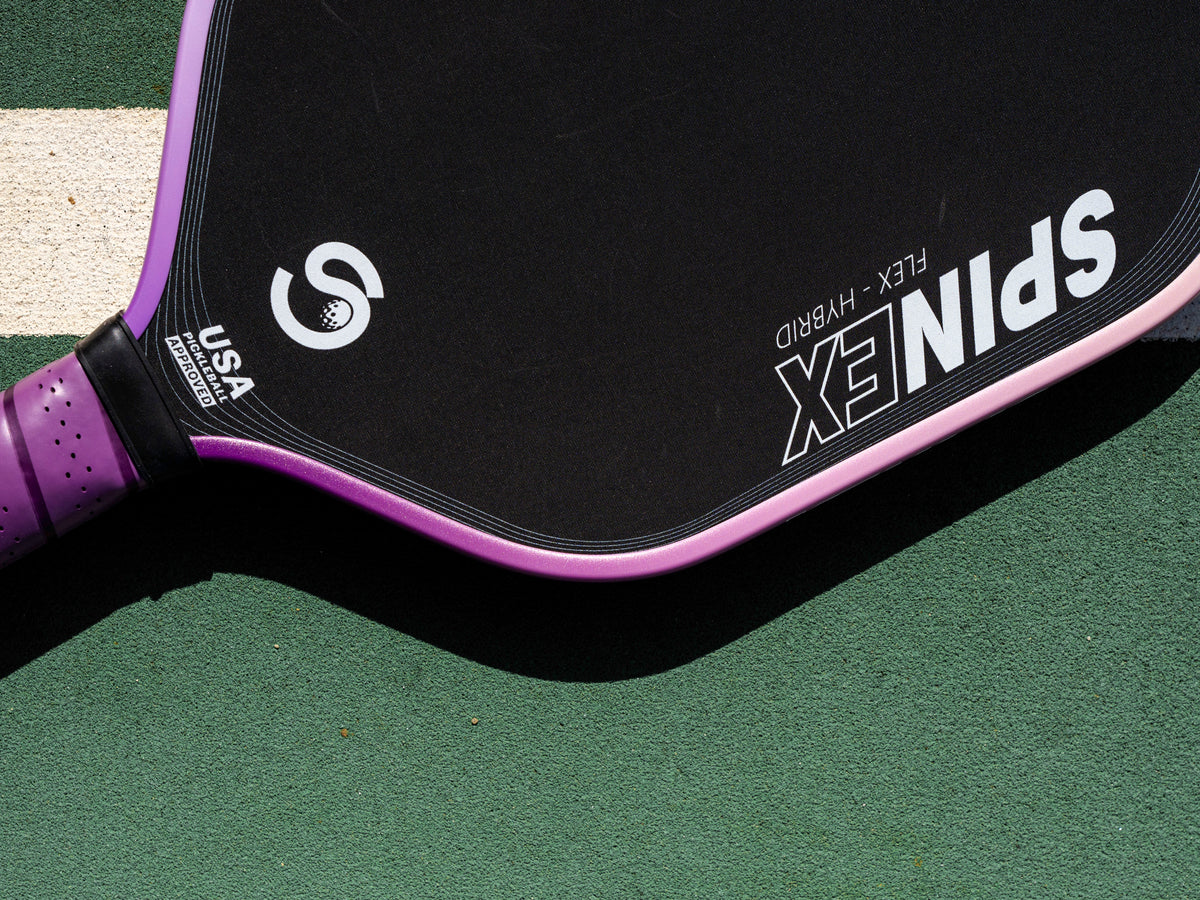
If you are comparing materials, our guide to carbon fibre vs fibreglass pickleball paddles explains the broader control, feel and durability trade-offs. The FLEX Hybrid uses a raw T700 carbon face and is positioned as a balanced, control-focused all-court paddle, not a shortcut that replaces technique.
Do not add aftermarket grit, sandpaper-style material or other surface treatments. If tournament legality matters, check the exact model on the approved list and keep the face in its original condition.
Keeping the face consistent
- Remove visible ball residue using the paddle maker's recommended cleaning method.
- Keep the face dry before play and avoid harsh or abrasive household cleaners.
- Replace a badly worn, cracked or delaminated paddle rather than modifying it.
- Try a fresh ball if spin suddenly drops; a worn, slick ball can change the result too.
Common spin mistakes and quick fixes
Flat swing
Symptom: fast ball that keeps sailing. Fix: start lower and finish higher before adding speed.

Face too open
Symptom: brushed ball climbs. Fix: close the face slightly and contact farther in front.
Grip too tight
Symptom: stiff, slow swing. Fix: relax the hand enough to accelerate smoothly through contact.
Trying to spin every ball
Symptom: errors on low or defensive balls. Fix: use a neutral face when balance and placement matter more.


Spinex FLEX Hybrid
Control-focused all-court paddle. 6-layer T700 carbon face, 16mm thermoformed core, USAP-approved.
A$199
Shop the FLEX Hybrid →Frequently Asked Questions
How do I add topspin to a pickleball shot?
Start the paddle below the ball, keep the face slightly closed, contact in front and brush low to high across the back of the ball. Finish near your shoulder. The upward swing path creates the forward rotation.
Do I need a special paddle to create spin?
No. Technique creates the spin. A clean paddle with a textured, approved surface can make the grip more consistent, but it cannot replace the low-to-high brushing motion.
Why does my topspin shot still go long?
The paddle face is probably too open, the swing is too flat, or you are adding pace before controlling the shape. Close the face slightly, finish higher and practise at a comfortable speed first.
Is topspin or slice better in pickleball?
They solve different problems. Topspin is useful for attacking serves, drives and roll volleys because it helps the ball dip. Slice slows the ball and keeps the bounce lower, which can help on returns and changes of pace.
What paddle surface is good for spin?
Many players like a textured raw-carbon face because it can provide predictable grip. However, the exact construction, face condition and player technique matter more than the material name alone.
How do I know whether my paddle is legal in Australia?
For a Pickleball Australia-sanctioned tournament, check that the manufacturer and exact model appear on the USA Pickleball or UPA-A approved list. Do not rely only on a printed logo, and do not add aftermarket surface texture.
How should I clean a pickleball paddle face?
Follow the paddle maker's instructions. Remove ball residue gently, keep the face dry and avoid harsh or abrasive household cleaners that could change the texture.
Master the swing first. Choose the paddle second.
Find your shop the range Review the beginner rulesLast reviewed: 22 July 2026. Technique guidance was checked against USA Pickleball coaching information, and Australian paddle-approval guidance was checked against Pickleball Australia. First-party observations are from Spinex demo sessions and regular use of our demo fleet; they are practical observations rather than controlled laboratory measurements. Spinex Pickleball designs and sells pickleball equipment in Australia, so product references are disclosed and kept secondary to the technique advice. Contact us if this guide needs an update.

Leave a comment
This site is protected by hCaptcha and the hCaptcha Privacy Policy and Terms of Service apply.