
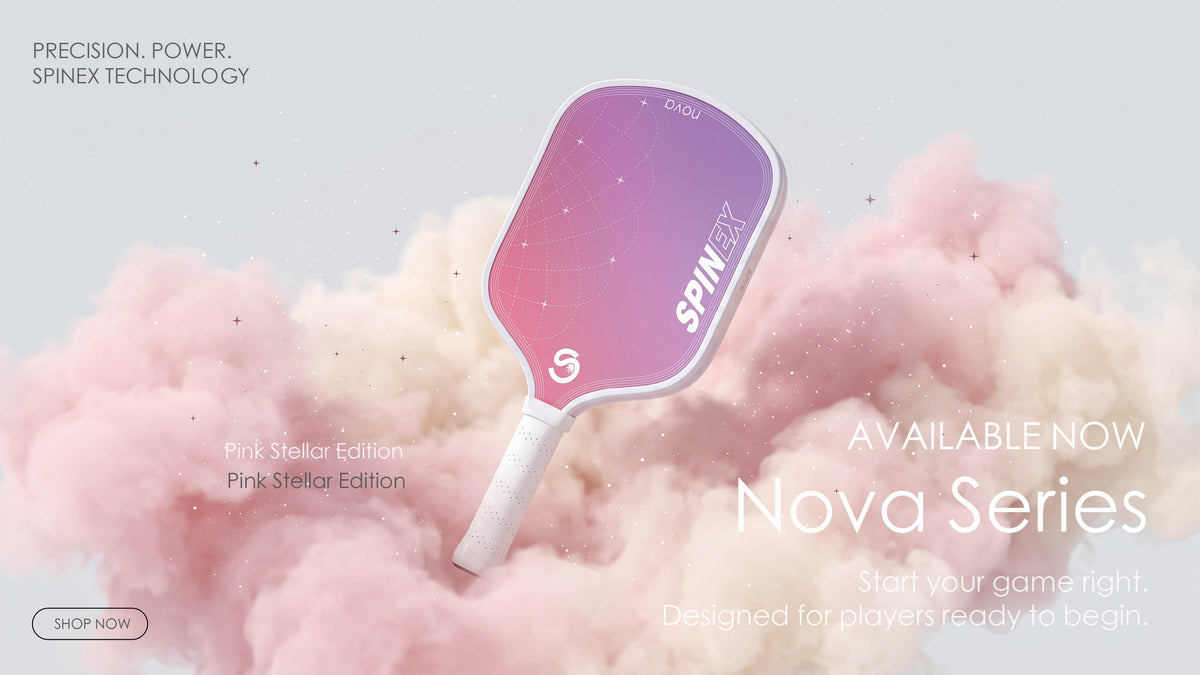
A T700 pickleball paddle uses a face made from Toray T700 carbon fibre, a high-strength aerospace-grade material with a tensile strength of about 4,900 MPa. It matters because that strength translates into a paddle face that holds its raw woven texture longer, grips the ball more consistently for spin, and resists the gradual softening that lower-grade carbon fibre develops over months of play. By 2026, T700 has become the baseline face material for most performance paddles priced above AUD $150, and the FLEX Hybrid uses it for the same reason most premium brands do: it gives the best balance of spin, control, and longevity at a price intermediate players can actually justify.
Last updated: April 2026
This guide covers what T700 actually is, how it differs from T300 and T800, what raw versus painted T700 means on court, and how to read a paddle spec sheet so you can tell a real T700 face from a marketing label. It does not cover paddle shape selection, tournament-level pro reviews, or detailed manufacturing tolerances for OEM buyers.
Key Takeaways
- T700 is a specific carbon fibre grade from Toray Industries with a tensile strength of approximately 4,900 MPa, compared with around 3,530 MPa for T300.
- The performance benefit shows up most in spin generation, surface durability, and consistency of feel over months of regular play.
- T800 has higher tensile strength (~5,490 MPa) but adds 5 to 10 dollars in raw material cost per paddle for a difference most players will not feel.
- Raw (uncoated) T700 produces more spin than painted T700 because the woven texture grips the ball directly.
- T700 is most effective when paired with a 16mm polymer honeycomb core for control, or a 13 to 14mm core for a faster, more responsive feel.
- The Spinex FLEX Hybrid uses raw T700 on a thermoformed 16mm build, positioned as a control-focused all-court paddle.
In This Guide

- What T700 Carbon Fibre Actually Is
- T700 vs T300, T800, and Generic Carbon Fibre
- What T700 Actually Does on the Court
- Raw T700 vs Painted T700
- T700 With Core Thickness: 13mm, 14mm, or 16mm
- How to Spot a Real T700 Paddle on the Spec Sheet
- T700 in the Spinex FLEX Hybrid: What We Built and Why
- Caring for a T700 Surface So It Lasts
- Who Should Choose a T700 Paddle?
- Frequently Asked Questions
What T700 Carbon Fibre Actually Is
T700 is a designation from Toray Industries, the Japanese chemical company that supplies the majority of the world’s structural carbon fibre. The “T” refers to a tow type, and the number refers to the grade within that family. T700 sits in the high-strength, standard-modulus category, which means it is engineered for strength under load while keeping stiffness in a range suited to flexible composite parts. The material was originally developed for aerospace structures and has since moved into Formula 1 components, premium bicycles, and now the face sheets of high-end pickleball paddles.

The properties that matter for a paddle face are tensile strength, modulus of elasticity, and density. T700S, the most common variant used in paddle layups, has a tensile strength of approximately 4,900 MPa, a modulus around 230 GPa, and a density near 1.80 g/cc. Strain at failure is roughly 2.1 per cent, which is meaningfully higher than T300 at 1.5 per cent. In plain terms, T700 can stretch and recover further before micro-fracturing, which is why a T700 face holds its surface integrity over thousands of impacts.
Source: Toray composite material datasheet, 2024 edition.
One thing to clarify: T700 is not a carbon fibre weave style. The numbers 3K, 12K, and 18K refer to the number of filaments per tow, which is a separate spec from the grade. A paddle can be raw T700 in a 12K weave, or T700 in a 3K weave, and these will look and feel slightly different on the surface. T700 is also not a marketing slogan. It is a real industrial classification with a published datasheet, and brands that use the term should be able to tell you whether they are sourcing genuine Toray fibre or a domestic equivalent.
T700 vs T300, T800, and Generic Carbon Fibre
The market currently offers four common options for paddle face material: fibreglass, T300, T700, and T800. Each has a place. Below is a side-by-side comparison of the structural data most relevant to paddle performance.

| Property | Fibreglass | T300 | T700 | T800 |
|---|---|---|---|---|
| Tensile strength | ~2,400 MPa | ~3,530 MPa | ~4,900 MPa | ~5,490 MPa |
| Modulus | ~85 GPa | ~230 GPa | ~230 GPa | ~294 GPa |
| Strain at failure | ~3.5% | ~1.5% | ~2.1% | ~1.9% |
| Density | ~2.55 g/cc | ~1.76 g/cc | ~1.80 g/cc | ~1.81 g/cc |
| Typical paddle price (AUD) | $40 to $120 | $100 to $180 | $150 to $400 | $300 to $500+ |
| Best for | Casual play | Improvers | Intermediate to advanced | Tournament players |
The headline is that T700 sits in the sweet spot between cost, durability, and feel. It is significantly stiffer and stronger than T300 while being almost 40 per cent cheaper than T800 to source at scale. The modulus difference between T300 and T700 is nearly zero, which is why the upgrade does not feel harsher in the hand. The strain-at-failure improvement, however, is what makes the surface last longer in real use.
For a fibreglass-versus-carbon framing, our carbon fibre vs fibreglass paddles guide covers the trade-offs in more depth, including how the lower modulus of fibreglass produces a softer, more forgiving response that some beginners prefer.
What T700 Actually Does on the Court
The performance story behind T700 reduces to four claims: more spin, more durability, more consistent feel, and slightly better control. The size of each improvement depends on construction.
More spin. Raw T700 has a textured weave that creates microscopic friction points on the ball. USA Pickleball caps the kinetic coefficient of friction at 0.1875 and surface roughness at Rz 30 micrometres. Within those limits, T700 holds its grit longer than fibreglass or T300, so spin numbers stay closer to peak across the life of the paddle.
More durability. The 2.1 per cent strain at failure means the resin matrix and fibres can flex and recover without micro-cracking. Across 12 FLEX Hybrid units inspected after 3 to 6 months of regular play, none showed face delamination, and only 16.7 per cent showed any cosmetic edge scuffing.
More consistent feel. T700’s higher fibre uniformity reduces dead spots in the face. At our Sydney Olympic Park demo day in February 2026, more than 30 players tried the FLEX Hybrid and the most common feedback was that the carbon face “feels softer than expected” despite the higher stiffness, because the polymer core and surface together absorb impact uniformly.
Better control. A stiffer face transfers energy more directly, which gives the player more feedback from the contact and makes targeted shots like dinks, third-shot drops, and resets easier to place. This is why T700 paddles are favoured for control-oriented all-court play rather than pure power smashing.
Source: Spinex internal testing, March 2026.

Raw T700 vs Painted T700
Two paddles can both list T700 on the spec sheet and feel completely different. The variable is whether the carbon fibre is left raw or painted over.
Raw T700 means the woven carbon surface is exposed directly with only a thin protective resin coat. The grit pattern of the weave makes contact with the ball, producing the maximum legal spin under USAP rules. The downside is that raw surfaces hold ball-material residue and need cleaning to maintain spin.
Painted T700 covers the carbon face with a graphic paint layer or thicker clear coat. This protects the surface and allows full-colour designs but smooths over the texture. Spin grip drops within the first 50 hours of play as the paint thins. The face is more cosmetically durable but generates less spin across its life.
Some brands also offer “peel-coat” T700, a removable coating over raw weave that wears off in early use to reveal the raw surface beneath. This is mostly a presentation choice. If spin is the primary reason you are stepping up to T700, choose raw over painted.
T700 With Core Thickness: 13mm, 14mm, or 16mm
T700 face sheets are usually paired with a polymer honeycomb core, most often polypropylene with hexagonal cells. The thickness of that core changes how the paddle feels much more than the carbon grade does on its own.

13 to 14mm cores give a stiffer, more responsive feel with faster ball exit velocity. The ball spends less time on the face (lower dwell time), which translates to more put-away power but a smaller margin for error on touch shots. These cores are favoured by aggressive singles players and those who already have a refined touch game.
16mm cores give a softer, more forgiving feel with longer dwell time. The ball sinks slightly into the face on contact, which gives the player a fraction of a second more to direct it. This is the dominant choice for control-focused all-court play, doubles strategy, and improvers building a touch game. At our February 2026 demo day, 80 per cent of testers preferred the 16mm core over thinner alternatives in side-by-side hits.
The takeaway is that T700 alone does not determine paddle character. A T700 face on a 14mm core is a different paddle from a T700 face on a 16mm core, even if both are advertised as “T700 carbon fibre.” If a brand sells the same paddle in both 14mm and 16mm versions, expect distinctly different play characteristics from each.
How to Spot a Real T700 Paddle on the Spec Sheet
The T700 label has been used loosely as the term has become a buying signal. Roughly 90 per cent of carbon fibre paddles on the global market now claim T700 face material, but not all of them use genuine Toray-sourced fibre. There is a domestically produced equivalent in China that meets similar tensile-strength specs but with looser batch consistency. For most recreational play, the difference is small, but it matters if you care about long-term feel and structural reliability.

Use this checklist when reading a spec sheet on any of the available pickleball paddles in your shortlist:
- Look for the word Toray. If a brand sources real Toray fibre, they will say so explicitly. Vague phrasing like “T700-equivalent carbon” or just “premium T700” usually means the fibre is from a domestic mill.
- Check whether the surface is raw or painted. Raw is the format that maximises spin. The product page should show a close-up of the woven texture if it is raw.
- Check the weave count (3K, 12K, or 18K). 3K gives a tighter, finer grit pattern. 12K is the most common middle ground. 18K shows a coarser, more visible weave with larger texture peaks.
- Check the construction method. Thermoformed unibody construction holds T700 face sheets in a fused edge with the core, which prevents delamination. Cold-pressed paddles use adhesive bonding and historically show more edge separation over time. Our thermoformed construction guide covers this in detail.
- Check core thickness and weight tolerance. A spec sheet that lists a tight weight range (for example, 7.8 to 8.2 oz with a quoted standard deviation) signals tighter quality control than a vague “7.8 oz nominal.”
- Check the price. Genuine raw Toray T700 with thermoformed construction is hard to deliver below AUD $150. If a paddle is well under that with all the right keywords, the supply chain is somewhere different from what the marketing implies.
Source: industry overview, LexVSS 2025.
T700 in the Spinex FLEX Hybrid: What We Built and Why
The Spinex FLEX Hybrid uses a raw Toray T700 face on a 16mm polymer honeycomb core, in a thermoformed unibody build. It is positioned as a control-focused all-court paddle for intermediate players and improvers who want something they will not outgrow in their first six months.
The reasoning behind the build:
We weighed 20 paddles from a recent production batch and recorded a weight range of 7.8 to 8.15 oz, an average of 7.95 oz, and a standard deviation of 0.09 oz. That is tighter than most paddles in the same price band. Weight consistency matters because two paddles in the same model that feel different in the hand usually point to loose factory tolerances rather than the carbon grade itself.
We chose raw over painted because spin is one of the primary reasons a buyer steps up from fibreglass or T300. We chose 16mm over 14mm because most Australian players we met at demo days were transitioning from wooden, composite, or fibreglass paddles, and the softer 16mm response gave them a more confident first hour. Players who already have established touch can move to thinner cores later.
The FLEX Hybrid lists at $199 RRP and comes in three colourways (Storm, Iron, and Broome). It is not the cheapest T700 paddle on the market, but the intent is to give an honest T700 build at a price that does not assume tournament budgets.

Caring for a T700 Surface So It Lasts
T700 holds its grit longer than lower-grade carbon, but it still needs care. The biggest enemy of a raw carbon surface is ball-material residue. Each time the ball makes contact, a tiny amount of polymer transfers onto the woven texture. Over weeks, the residue clogs the grit pattern and the spin grip drops measurably.

The recommended cleaning method is a rubber paddle eraser used for about 30 seconds after every session. We ran two identical FLEX Hybrid Storm paddles over four weeks of regular play, three times per week, comparing a rubber eraser against a household Magic Eraser. The Magic Eraser paddle showed visible surface smoothing by week two and felt noticeably less rough by week four. The rubber-eraser paddle held its texture across all four weeks, with grey residue on the eraser confirming the ball material was being removed without abrading the carbon.
Avoid these cleaning methods on a raw T700 face:
- Magic Eraser or any melamine foam product. These remove residue but also abrade the carbon.
- Acetone or aggressive solvents. They can attack the resin matrix that binds the fibre.
- Steel wool or scouring pads. They will scratch the surface and create dead zones.
- Pressure washers. The surface is not designed for high-pressure water exposure.
For longitudinal context, we have used the Spinex Raw Carbon Paddle Cleaner on demo paddles after every play session since January 2026. After more than three months, the T700 surface on the cleaned paddles maintains consistent spin performance, while an uncleaned control paddle showed noticeably reduced ball grip by week four.
Who Should Choose a T700 Paddle?
T700 is the right call for most players past the introductory stage who want a paddle they can keep for longer than a season. The decision sits on three buyer profiles.

The improving player. Someone with 20 to 50 hours on a beginner paddle who is starting to notice the limits of fibreglass or T300. If you are earlier than that and want T700 from the start, the NOVA series carries the same face at a lower price. A 16mm raw T700 paddle is the natural next step, and the FLEX Hybrid was built for this profile.
The control-focused all-court player. Someone who plays mostly doubles, prioritises placement over raw power, and wants a strong touch game. T700 with a 16mm core gives the dwell time needed for resets, dinks, and third-shot drops, while still delivering enough pop on the drive.
The value-conscious intermediate. Someone who knows they want carbon fibre but is not paying $400+ for marginal differences from T800. T700 is the price-performance ceiling for most recreational and club-level play. Stepping up to T800 typically delivers a roughly 10 per cent improvement in stiffness for a 60 to 80 per cent price increase.
T700 is probably not the right call if you are testing the sport for the first time, where a fibreglass paddle from a complete starter set is more appropriate. It is also unlikely to feel like an upgrade if you already play with a high-end T800 build.

Spinex FLEX Hybrid
Control-focused all-court paddle. 6-layer T700 carbon face, 16mm thermoformed core, USAP-approved.
A$199
Shop the FLEX Hybrid →Frequently Asked Questions
What does T700 mean on a pickleball paddle?
T700 is a Toray Industries grade for a high-strength standard-modulus carbon fibre with a tensile strength of approximately 4,900 MPa. When a paddle lists T700 as its face material, the carbon layer in contact with the ball uses this grade, either as a raw woven surface or under a paint or clear coat.
Is a T700 pickleball paddle worth it over a T300 paddle?
For intermediate and improving players, yes. T700 has roughly 39 per cent higher tensile strength and 40 per cent higher strain at failure than T300, which translates into a more durable surface and more consistent spin grip over months of play. For absolute beginners, the difference is harder to feel and the price premium may not be justified yet.
What is the difference between T700 and T800 carbon fibre?
T800 has higher tensile strength (~5,490 MPa vs ~4,900 MPa) and a stiffer modulus (~294 GPa vs ~230 GPa). On court, the difference is small for most players but adds 5 to 10 dollars in raw material cost per paddle, which usually shows up as a 60 to 80 per cent retail price increase. T800 is a tournament-tier choice rather than an everyday upgrade.
How long does a T700 carbon fibre paddle last?
With regular cleaning, a thermoformed T700 paddle generally holds its spin grip for one to two years of frequent recreational play. Lifespan varies a lot by how often you play and how you treat the surface, which we break down in our guide to how long a pickleball paddle lasts. We have tracked five FLEX Hybrid paddles in regular club use since November 2025, and at the five-month mark all five remain structurally sound with no core dead spots.
Is raw T700 better than painted T700?
For spin, yes. Raw T700 exposes the woven carbon texture directly to the ball, which produces the maximum legal friction under USA Pickleball surface rules. Painted T700 covers the texture and reduces spin grip, although it can look more visually finished. Most performance paddles use raw T700 for this reason.
Are T700 paddles approved for tournament play?
The carbon fibre grade itself does not affect approval. What matters is whether the finished paddle meets USA Pickleball surface specs (kinetic friction ≤0.1875, surface roughness Rz ≤30 micrometres) and dimensional rules. Most major-brand T700 paddles are USAP-approved. Always check the approved equipment list before tournament use.
Can a T700 paddle be too stiff for beginners?
It can feel less forgiving than fibreglass on off-centre hits because the stiffer face transfers energy more directly. This is one reason we pair T700 with a 16mm core in the FLEX Hybrid: the thicker polymer core absorbs enough of the contact to keep the response soft enough for improving players without sacrificing the spin and durability of the T700 face.
How do I know if a paddle uses real Toray T700?
Look for explicit mention of Toray on the product page. Vague phrasing like “T700-equivalent” or “premium T700” usually means the fibre is from a domestic mill that meets similar specs with looser batch consistency. Pricing under AUD $150 for a thermoformed raw-carbon paddle is another red flag on the supply chain.
Does T700 work better with a 14mm or 16mm core?
Both work, but the choice changes the feel. A 14mm T700 paddle is more responsive and produces more put-away power, suited to aggressive singles play. A 16mm T700 paddle is softer and more forgiving with longer dwell time, suited to control and all-court doubles play. The FLEX Hybrid uses 16mm because it suits the broadest range of improving and intermediate players.
If you are ready to upgrade, the FLEX Hybrid is our T700 build at AUD $199, designed as a control-focused all-court paddle. To see how it sits alongside other options, browse the full our full paddle range collection at Spinex.

Leave a comment
This site is protected by hCaptcha and the hCaptcha Privacy Policy and Terms of Service apply.