
Pickleball gets sold to tennis players as "easier tennis." It is a fast pitch and the comparison is true on the surface, but the framing is the surest way to plateau in pickleball quickly. The two sports look related and reward almost opposite skills. We have watched experienced 4.0 tennis players walk onto a pickleball court at our Sydney demo days and lose to club intermediates who have never held a tennis racquet, because the tennis instincts that win at one game lose points in the other. The good news is that tennis players who treat pickleball as its own game improve faster than complete beginners, often dramatically faster. The catch is that "its own game" is not optional.
- A pickleball court is 6.10m by 13.41m, roughly a quarter the area of a singles tennis court (8.23m by 23.77m).
- A pickleball paddle weighs about 220g; a typical adult tennis racquet weighs 280g to 320g strung. The lighter implement and shorter reach change every swing pattern.
- Pickleball uses underhand serves, two-bounce starts, a non-volley zone (the "kitchen"), and games to 11 with rally-side scoring only. None of this exists in tennis.
- Tennis players adapt fastest when they shorten their swing, get to the kitchen line, and stop trying to hit winners from the baseline. Pickleball rewards patience and angles, not raw power.
- If you are an Aussie tennis player thinking about a paddle, look for control-focused, all-court paddles in the 220g range with a 16mm core, not the heavy "power" paddles you might assume from your tennis-racquet preferences.
The rest of this guide walks through the differences using a five-axis comparison the Spinex team uses on demo days when tennis crossovers ask the same questions: court, equipment, rules, physics, and learning curve. Skim the comparison table, read the sections that matter most to your situation, and use the FAQ at the bottom for the quick yes/no answers that come up at the club.
How the courts compare
The first thing tennis players notice is how small a pickleball court feels. It is not a perception. A pickleball court is 6.10m wide and 13.41m long (20ft by 44ft), which is the same footprint as a doubles badminton court. A singles tennis court is 8.23m wide and 23.77m long, roughly four times the playing area. The net is also lower, sitting at 91cm at the posts and 86cm at the centre, compared with 107cm and 91.4cm in tennis.

Smaller court, lower net, slower ball: rallies stay alive. Where a tennis point can end on a single big serve and a forehand winner from the baseline, a pickleball point routinely runs 8 to 20 shots, with both teams tucked up at the kitchen line trading dinks. The geometry rewards patience, ball placement, and short angles. It punishes the tennis instinct to step back, load up, and rip a winner.
How the equipment differs
Tennis racquets and pickleball paddles look like they belong on the same shelf, then you pick up one of each and the family resemblance ends. The paddle is shorter (16.5 inches versus a tennis racquet's typical 27 inches), lighter, has no strings, and has a flat solid face instead of a strung head. The ball is plastic with holes drilled through it, weighs about 26g, and travels noticeably slower through the air than a felt tennis ball.

| Spec | Pickleball | Tennis (singles) |
|---|---|---|
| Court size | 6.10m × 13.41m | 8.23m × 23.77m |
| Net height (centre) | 86cm | 91.4cm |
| Implement | Solid paddle, ~16.5″ | Strung racquet, ~27″ |
| Implement weight | ~220g (7.8 oz typical) | 280–320g strung |
| Ball | Plastic, 40 holes (outdoor), ~26g | Felt-covered rubber, ~58g |
| Scoring | Games to 11, win by 2, server scores only | Sets, win 6 games by 2, all points score |
| Serve | Underhand only, below the waist | Overhand, no body restriction |
| Two-bounce rule | Yes (return of serve must bounce) | No |
| Non-volley zone | Yes (the "kitchen", 2.13m from net) | No |
The weight difference matters more than tennis players expect. Across 20 FLEX Hybrid paddles we weighed in March 2026 from a single production batch, the average came in at 7.95 oz (225g) with a standard deviation of 0.09 oz, well inside the 7.8–8.2 oz range listed on the spec sheet (entry TS004 in our internal testing log). A paddle that sits between 220g and 230g feels light to a tennis player swinging a 300g racquet for the first time, and that lightness is intentional. Pickleball rallies happen at the kitchen line, where you need a fast hand for blocks and counters. A heavier "tennis-feel" paddle feels stable on a baseline drive but slow when an opponent body-bags you at the line.
The other surprise is the lack of strings. Modern pickleball paddles use a polymer honeycomb core wrapped in a thermoformed carbon fibre or fibreglass face. There is no string bed to "absorb" the ball the way a tennis racquet does, so spin and control come from the friction of the face material, not from string pattern or tension. This is why surface care matters more in pickleball than tennis.
How the rules and scoring differ
Pickleball rules carry a few constructs that have no tennis equivalent. The most important three: the underhand serve, the two-bounce rule, and the non-volley zone. Get these right and a tennis player can hold their own at a club open play within a session or two. Skip them and the same player will be making unforced errors all night.

The serve
You serve underhand, with the paddle below your wrist, and you must contact the ball below your waist (technically below the navel under the volley-serve rule). No tennis-style flat bomb, no kick serve, no slice down the T. The serve is intentionally a neutral start, not a weapon. After a 2021 rule change, the drop-serve became fully legal too: drop the ball from any height (you cannot toss or spike it down) and hit it after the bounce, with no swing or contact restrictions on the drop-serve version.

The two-bounce rule
The receiving team must let the serve bounce before returning it. The serving team must then let that return bounce before hitting their first volley. So the first two shots of every rally are off the bounce. No rushing the net to volley a serve return, no serve-and-volley game. After those two bounces, normal volleys are allowed, except in the kitchen.
The kitchen
The non-volley zone is a 2.13m (7-foot) area on each side of the net where you cannot volley the ball, meaning you cannot hit it in the air while standing in or touching the kitchen. You can step into the kitchen to play a ball that has bounced. Tennis crossovers lose most of their early points to kitchen faults. At our February demo day at Sydney Olympic Park, the kitchen-step instinct was the single most common fault we logged among players with active tennis backgrounds: stepping into the zone on follow-through, planting a foot in the kitchen for an aggressive volley, or carrying their momentum across the line after putting the ball away. Get the footwork right and pickleball makes sense. Get it wrong and the rule list reads like a trap.

Scoring
Games go to 11, win by 2. Only the serving side scores points. Doubles scoring uses three numbers (serving team score, receiving team score, server number 1 or 2) and the called score before each serve sounds like "5–3–2" rather than "30–love." There are no sets, no tiebreaks, no second serves. Tennis players find the simplification refreshing once it clicks, and confusing for the first session or two.
How it actually feels to play
The smaller court and slower ball reshape what wins points. In tennis, a big serve and a forehand winner from the baseline can win you 60% of points in a recreational match. In pickleball, you serve underhand into a 6-metre wide box, the ball bounces lazily, your opponent returns it deep, and now both teams have time to walk to the kitchen line. The first big strategic decision of every rally is not "which weapon do I deploy" but "how fast can I get to the kitchen without losing position."
Once everyone is at the kitchen line, points are decided by soft hands. Dinks (controlled drop shots that land in the opponent's kitchen), resets (taking pace off a hard shot to neutralise it), and patient placement matter more than racquet-head speed. The reward structure flips from tennis. Power is useful but not decisive. Patience, angles, and unforced-error avoidance are decisive. We see this every demo day, and it is the single biggest re-wiring tennis players need.
At that February demo day, the most common feedback from tennis players who picked up a pickleball paddle for the first time was "feels softer than I expected." A close second: "I keep wanting to step into the kitchen on my volleys." Both reactions are useful diagnostics. The softness is the polymer core absorbing impact (a string bed does the same job in tennis but with a different feel). The kitchen problem is the deepest tennis instinct of all: in tennis you charge the net to finish a point, and in pickleball that same charge gets called as a fault.

Should tennis players make the switch (or play both)?
Honest answer: most tennis players we know in Sydney, Brisbane, and Perth play both. The two sports complement each other and the equipment costs are low enough that picking up pickleball does not mean giving up a tennis membership. If you are a tennis player asking whether to switch, the more useful question is "what do I actually want from a racquet sport now?"

If you want long, high-aerobic singles rallies, deep court coverage, and a sport you can play to a serious competitive level for decades, tennis is still better designed for that. If you want a social game you can play indoors on rainy Melbourne afternoons, with mixed-skill partners, where 8 people can rotate through one court, and where a gentle joint-load lets you play 3 hours without your knees complaining, pickleball is hard to beat. We have a couple of older club members in their 70s who switched from tennis after knee surgery and now play more pickleball in a week than they used to play tennis in a month.
If we had to give a directional answer: if you are over 55, dealing with knees, shoulders, or wrists, or struggling to find tennis partners at your level, pickleball is the better default. The lower joint load and easier social entry win. If you are under 35, fit, and play tennis competitively, stay with tennis as your main sport and treat pickleball as a fun second game on rainy days, not a replacement. If you are between 35 and 55, the honest answer is play both. The two sports build different fitness layers and the gear cross-cost is small.
What to buy if you're trying it
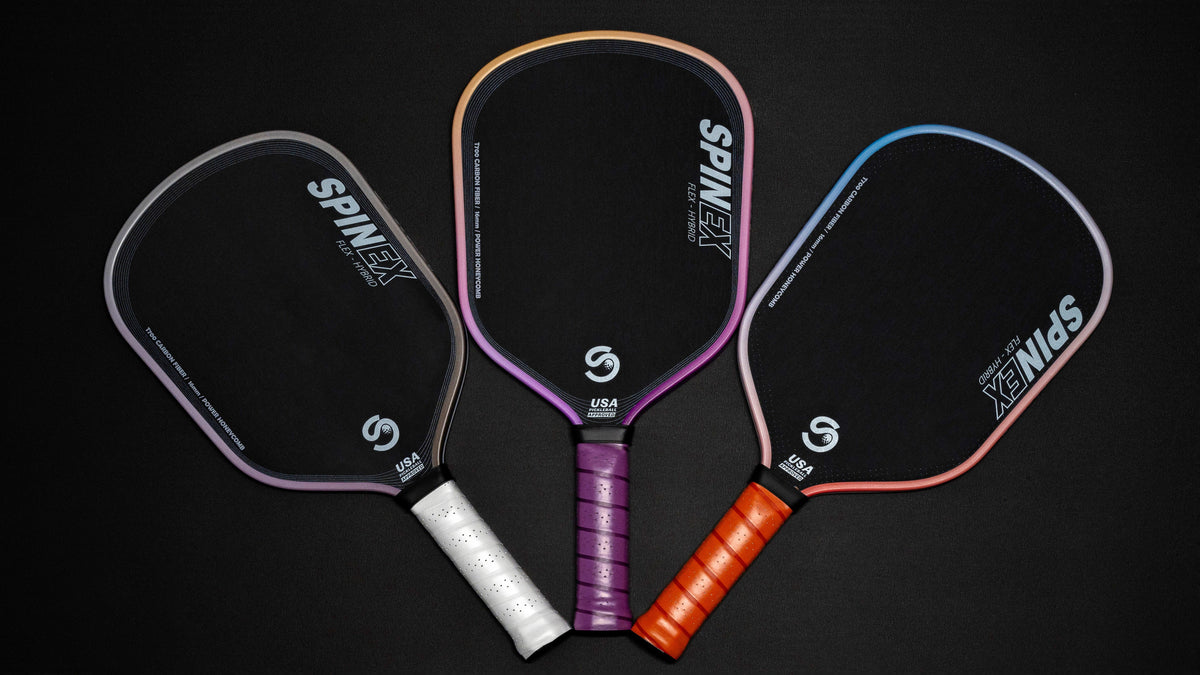
Tennis players often gravitate toward heavy paddles because that is what their tennis racquet feels like. This is the most common new-player mistake we see. A paddle in the 7.8 to 8.2 oz range with a 16mm core gives you a forgiving sweet spot, fast hands at the kitchen, and enough plough-through for baseline drives when you do choose to swing. A control-focused, balanced all-court paddle like the FLEX Hybrid at A$199 is designed for exactly this profile. Heavier "power" paddles (8.4 oz and up) are what experienced players sometimes graduate to once their soft game is dialled in, not where tennis crossovers should start.

For the full equipment shortlist, our best pickleball paddles for beginners in Australia guide walks through what matters at the entry level. Spinex Pickleball ships paddles, balls, and starter sets across Australia.
What's changing for pickleball in Australia
Pickleball is one of the fastest-growing racquet sports in Australia by participation, although it is still small in absolute numbers compared with tennis. The national governing body, Pickleball Australia, has been publishing a rising affiliated-player count across 2025, and the count keeps climbing as council courts get permanent lines painted alongside tennis courts. Major centres now include Sydney Olympic Park Pickleball Courts, multiple dedicated venues across Brisbane and the Gold Coast, and rapidly expanding club programs in Perth, Adelaide, and regional Victoria.

Two trends are worth watching from a tennis player's perspective. First, hybrid clubs: traditional tennis clubs are converting one or two of their underused courts to pickleball lines, which means existing tennis members can try pickleball without joining a separate club. Second, equipment is consolidating around 220–230g, 16mm-core, T700 carbon fibre face paddles as the default for intermediate players. The "what should I buy" question that used to need a 30-minute conversation can now be answered with a category.

Spinex NOVA
Built for beginners and social play. T700 carbon face, 16mm thermoformed core, forgiving widebody shape.
A$139
Shop the NOVA →Frequently Asked Questions
Is pickleball easier than tennis?
Easier to start, harder to master at the top. Most adults can hold a recreational rally on day one, which takes weeks in tennis. Competitive pickleball at the 4.0+ skill level rewards a level of touch, patience, and partner coordination that takes years to develop, similar to doubles tennis. "Easier" depends on what you mean.
Can tennis players easily transition to pickleball?
Yes for hand-eye and footwork, no for swing length and net strategy. Tennis players adapt fastest when they shorten their swing, get to the kitchen line on every rally, and stop trying to hit winners from the baseline. The biggest fault to unlearn is the "step into the volley" tennis habit, which becomes a kitchen fault in pickleball.
What is the main difference between a pickleball paddle and a tennis racquet?
A pickleball paddle is shorter (16.5″ versus 27″), lighter (around 220g versus 280–320g for a strung tennis racquet), and has a solid stringless face. The shorter, lighter implement gives you faster hands at the kitchen line but less reach and momentum on baseline drives. Spin and control come from the paddle face material rather than from a string bed.
How big is a pickleball court compared to a tennis court?
A pickleball court is 6.10m by 13.41m (20ft by 44ft), which is the same as a doubles badminton court. A singles tennis court is 8.23m by 23.77m. The pickleball court is roughly a quarter of the playing area, with a net 5cm lower at the centre.
Do you serve overhead in pickleball like in tennis?
No. Pickleball serves must be underhand, with the paddle below the wrist at contact, and the ball must be struck below the waist. The drop-serve variation lets you bounce the ball and hit it off the bounce with more swing freedom, but a tennis-style flat overhand serve is not legal.
What is the kitchen rule in pickleball?
The kitchen is the 2.13m (7-foot) non-volley zone on each side of the net. You cannot volley the ball (hit it in the air) while standing in or touching the kitchen, including a follow-through that carries you into the zone. You can step into the kitchen to play a ball that has bounced. The rule is the single biggest source of unforced errors for tennis players new to pickleball.
Is pickleball replacing tennis in Australia?
No, but it is growing alongside tennis on shared courts. Pickleball Australia's affiliated player count has been rising across 2025, and many tennis clubs in Sydney, Brisbane, Perth, and regional Victoria have added pickleball lines to existing courts. Most active racquet players in Australia who try pickleball end up playing both rather than picking one.
Do I need different shoes for pickleball than tennis?
Tennis shoes work fine for pickleball, especially for outdoor play on hard courts. The footwork is shorter and more lateral than tennis baseline play, but the shoe demands are similar (lateral support, herringbone or non-marking sole for indoor courts). Running shoes are not a good substitute because they lack lateral support.
Tennis player thinking about your first paddle?
Browse the shop the range rangeLast reviewed: April 2026. Court and net measurements are sourced from the USA Pickleball rulebook (adopted by Pickleball Australia) and the ITF Rules of Tennis. Internal testing data is logged in entries TS004 (paddle weights, 20-paddle batch, March 2026) and DE001 (Sydney Olympic Park demo day, February 2026). This article is written and published by the Spinex Pickleball team. We design paddles and sell pickleball gear in Australia; where we recommend Spinex products it is because we believe they are a fair fit for the problem being discussed. We aim for honest, useful guidance even when the best answer is a different brand or simply playing both sports. Get in touch if you have questions or want to book a demo.

Leave a comment
This site is protected by hCaptcha and the hCaptcha Privacy Policy and Terms of Service apply.