Most paddle reviewers default to a simple line: elongated for power, standard for control. It is a clean rule, and it is mostly wrong. After weighing 20 paddles in our Sydney workshop, running a Sydney Olympic Park demo day, and tracking five paddles through five months of regular club play, we keep watching shape sit behind weight, core thickness, and grip technique in how a paddle actually plays. Shape matters, but it is rarely the first thing that should change when your game stalls.
This guide covers what counts as elongated, how shape changes feel on court, and which players should genuinely care about the difference. We will also be honest about where the Spinex FLEX Hybrid fits on the spectrum, because the answer is not a marketing line.
- Elongated paddles are roughly 16.4 to 17 inches long and around 7.0 to 7.5 inches wide. Standard paddles are roughly 16 inches long and 8 inches wide. USA Pickleball caps total length plus width at 24 inches and length alone at 17 inches.
- Going elongated gives you about 0.5 inches of extra reach, slightly higher tip-speed, and a smaller forgiving sweet spot. Standard shapes give you a wider hitting zone and faster hands at the net.
- For most players moving from a beginner paddle to a serious one, shape is the third lever to pull. Core thickness and weight do more for your game in the first six months.
- What counts as an elongated pickleball paddle?
- How shape actually changes the way a paddle plays
- The Spinex Shape Decision Matrix
- Where the FLEX Hybrid sits, honestly
- How we tested this
- Common mistakes when switching shape
- What's changing in paddle shape
- If you want to read more
- Frequently Asked Questions
What counts as an elongated pickleball paddle?
Pickleball paddles are bound by one rule that matters here: under USA Pickleball's equipment standards, the combined length and width of a paddle cannot exceed 24 inches, and length alone cannot exceed 17 inches. Pickleball Australia sanctioned tournaments use the 2026 GPF Rule Book, the international edition of the USA Pickleball rulebook, so the same caps apply on court here.

Within those limits, manufacturers cluster around three rough shapes:
- Standard (or "wide-body"): roughly 16 inches long, 8 inches wide. Big sweet spot, fast hands, easier to swing through quickly.
- Hybrid: roughly 16.3 to 16.5 inches long, 7.5 to 7.7 inches wide. A small length-for-width trade. The Spinex FLEX Hybrid sits here.
- Elongated: roughly 16.5 to 17 inches long, 7.0 to 7.25 inches wide. More reach, more tip-speed at the same swing, narrower sweet spot.
The names overlap between brands, and "hybrid" in particular gets used loosely. When you read a spec sheet, look at the actual length and width before you trust the marketing label. A paddle sold as "elongated" at 16.4 by 7.5 inches is barely longer than a standard, and you will not feel the difference.
How shape actually changes the way a paddle plays
The four physical levers that change with shape are reach, sweet spot, swing weight, and twist torque. Each one shows up in a different part of the game.
Reach. Going from 16 inches to 16.5 inches gives you about half an inch of extra coverage. That sounds small. On a stretched dig at the kitchen line, half an inch is often the difference between a clean reset and a ball off the edge guard.
Sweet spot. A wider face spreads the sweet spot more evenly across the surface. A narrower face pushes the sweet spot up toward the tip. If your contact is consistent, an elongated paddle rewards you with more pop on the same swing. If your contact wanders, it punishes you with miss-hits at the throat and the sides.
Swing weight. Two paddles can weigh the same on a scale and still feel completely different. Elongated paddles concentrate mass further from your hand, which raises the swing weight and slows down hand-to-hand exchanges at the net. Standard shapes feel quicker for the same static weight.
Twist torque. Off-centre contact rotates the paddle in your hand. The further the contact is from the central axis, the more twist you get. Elongated paddles, with their narrower face, produce noticeably more twist on side-of-paddle hits. A thermoformed unibody construction reduces the wobble that follows, which is why many serious elongated paddles are thermoformed.

The Spinex Shape Decision Matrix
To stop the shape question from being a coin flip, we built a simple table we use when fitting players at demo days. We call it the Shape Decision Matrix. It groups paddles into the three real shape categories you will encounter, plus the maximum-legal outlier, and pairs each one with the player profile that actually benefits and the trade-off you accept.

| Shape | Length × Width | Best for | Trade-off |
|---|---|---|---|
| Standard / Wide-body | ~16.0" × 8.0" | Net play, hand battles, players still building consistent contact | Less reach on stretched defensive shots |
| Hybrid | ~16.3 to 16.5" × 7.5 to 7.7" | Improving players, balanced all-court games, players who do not know yet which style suits them | Not extreme in either direction |
| Elongated | ~16.5 to 17.0" × 7.0 to 7.25" | Singles, baseline drivers, taller players, consistent contact players who want reach | Smaller sweet spot, more twist on off-centre hits, slower at the kitchen |
| Maximum legal | 17.0" × 7.0" (or any combo summing to 24") | Specialist tournament use | Forgiveness drops fast outside the tip area |
The matrix is not magic. It is a way to stop yourself buying a 17-inch paddle because a YouTube pro uses one, and to start asking what your last 50 unforced errors actually looked like. If most of your misses are on the side of the face, you do not need more reach, you need a wider sweet spot.
Where the FLEX Hybrid sits, honestly

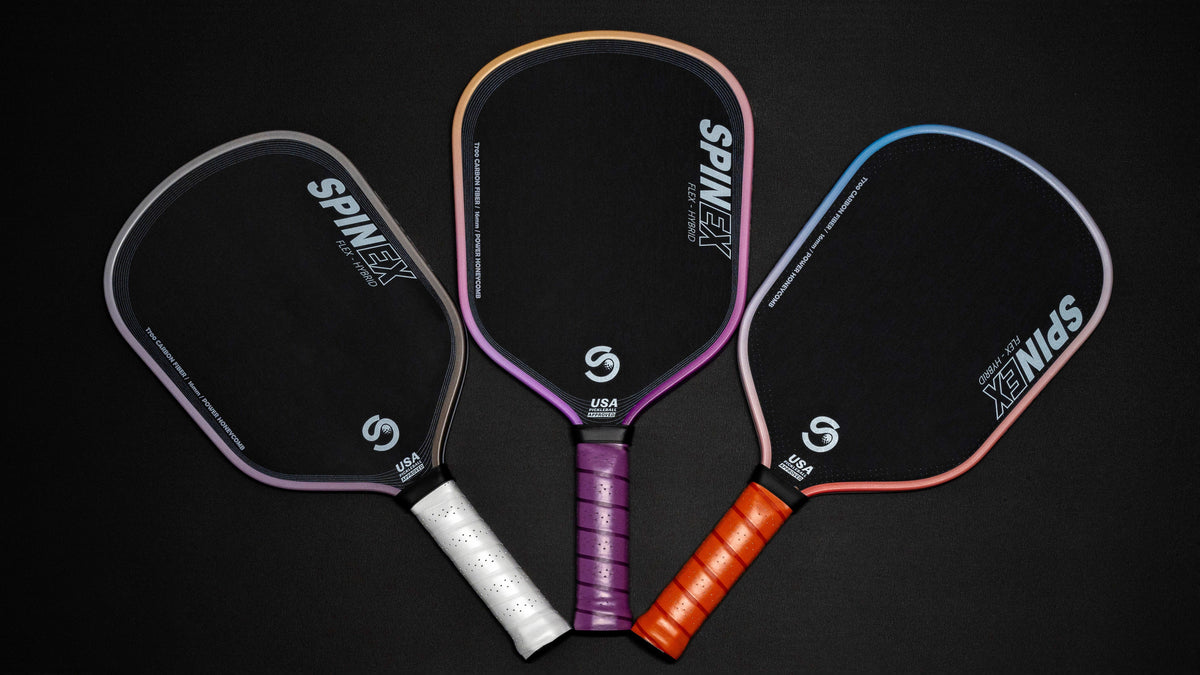
The Spinex FLEX Hybrid is 16.32 inches long and 7.68 inches wide. By the strict numbers it is at the elongated end of "hybrid", or the short end of "elongated", depending on whose taxonomy you read. We position it as a hybrid because it gives you most of the reach benefit without the sweet-spot cliff that comes with going to a 17-inch paddle.
The honest version: if you want a true power-tour elongated shape with the smallest sweet spot and the longest reach, the FLEX Hybrid is not that paddle. We do not build one of those, and we are not going to pretend the 16.3-inch hybrid is the same thing. What it is, instead, is a forgiving paddle for players who are still developing consistent contact but want the slight reach edge a hybrid gives over a 16-inch standard. That is a much larger group of Aussie players than the tour-elongated buyer.
How we tested this
Two findings from those sessions changed how we talk about shape:

First, at the February 2026 Sydney Olympic Park demo, 80 percent of the more than 30 players who hit hybrid and thinner shapes back to back preferred the 16mm hybrid over a thinner, more elongated demo paddle for everyday play. The most common comment was that the hybrid "feels softer than expected for a carbon fibre face." That tells us core thickness and softness register more strongly with most players than the half-inch of extra reach. Worth noting: this was a brand-run demo, not a blinded controlled trial, so treat the headline number as directional rather than scientific.
Second, the five paddles in long-term tracking, played three to four times a week from November 2025 to now, all stayed structurally sound through five months of regular play. No core dead spots, no edge delamination, only routine overgrip changes (one player went through four). For a 16.3-inch shape with the slightly higher twist torque that comes with that length, the thermoformed unibody build held up.
Common mistakes when switching shape
The pattern we see most often at clubs: a player upgrades from an entry-level wide-body to a 17-inch elongated paddle because a friend swears by it. Inside two weeks they are mishitting more, complaining about a "dead" sweet spot, and quietly reaching for the old paddle on tight points. The paddle is not bad. The shape jump was just too big.

A few specific traps to avoid:
- Skipping the demo. Shape is the part of paddle feel that does not translate from spec sheets. A 30-minute hit before you buy is worth more than ten reviews.
- Ignoring core thickness. If you are going from a 13mm to a 16mm core at the same time as you go elongated, you have changed two big variables and will not know which one moved your shots.
- Assuming elongated equals power. Most of the power in modern thermoformed paddles comes from the core, not the shape. A 16mm thermoformed standard hits harder than a 14mm cold-pressed elongated, in our experience.
- Buying a tour-elongated paddle as your first serious paddle. The smaller sweet spot will hide what your contact is actually doing. Better to upgrade to a hybrid first, then move to elongated only if you have data showing you would benefit.
What's changing in paddle shape
Looking ahead through 2026 and into 2027, three shifts are worth watching for Aussie players.

USA Pickleball has tightened its equipment performance specifications, with new paddle testing protocols that focus on power output and surface texture in addition to dimensions. The upshot is that pure shape advantage gets narrowed by other certified specs, which makes "elongated for power" an even weaker rule of thumb.
On the manufacturing side, hybrid shapes around 16.3 to 16.5 inches are becoming the new default for premium paddles aimed at improving players. The all-out 17-inch elongated category is increasingly a specialist singles and baseline-driving tool, not a general-purpose paddle. We expect the gap between hybrid and elongated to widen, not shrink.
For brand discovery, players in Australia, Singapore, Malaysia, and the Philippines are starting to compare paddles by spec sheet rather than by which influencer they saw first. That is good news for buyers. It also means a brand like Spinex Pickleball needs to be honest about what its paddles are and are not, because the data is being checked.
If you want to read more
Shape is one of three big paddle decisions, alongside core thickness and weight. If you are not yet sure whether your game leans toward control or power, our control vs power paddle guide is the natural next step.


Spinex FLEX Hybrid
Control-focused all-court paddle. 6-layer T700 carbon face, 16mm thermoformed core, USAP-approved.
A$199
Shop the FLEX Hybrid →Frequently Asked Questions
What is an elongated pickleball paddle?
An elongated pickleball paddle is one with a longer, narrower face than the traditional wide-body shape. Most elongated paddles measure between 16.5 and 17 inches in length and 7.0 to 7.25 inches in width. The shape gives players more reach and tip-speed, with the trade-off of a smaller sweet spot.
Are elongated paddles better for beginners?
For most beginners, no. The narrower face means a smaller forgiving zone, so off-centre hits are punished more. Beginners and improving players usually develop faster with a standard or hybrid shape that has a wider sweet spot. A widebody NOVA such as NOVA is built around exactly that. Move to elongated later if you want more reach and your contact is already consistent.
Is the Spinex FLEX Hybrid an elongated or standard paddle?
The FLEX Hybrid is 16.32 inches long and 7.68 inches wide, which sits at the boundary between hybrid and elongated. We call it a hybrid because it gives you most of the reach benefit of an elongated paddle while keeping a more forgiving sweet spot than a true 17-inch elongated shape.
What is the maximum legal paddle length in pickleball?
Under USA Pickleball equipment standards, paddle length cannot exceed 17 inches, and the combined length plus width cannot exceed 24 inches. Pickleball Australia sanctioned tournaments use the 2026 GPF Rule Book, the international edition of the USA Pickleball rulebook, so the same limits apply on court here.
Do elongated paddles really hit harder?
Slightly, in theory, because the longer paddle length lifts tip-speed at the same swing speed. In practice, core thickness and core composition affect raw power output more than shape does. A 16mm thermoformed standard paddle will usually feel more powerful than a 14mm cold-pressed elongated.
Which paddle shape is best for spin?
Spin is mostly a function of surface texture, not shape. Both elongated and standard paddles can produce strong spin if the face is a textured carbon fibre or thermoformed surface. Shape only matters for spin at the margins, where the longer face of an elongated paddle gives you a slightly larger window for brushing the ball at the tip.
Can I switch from a standard to an elongated paddle mid-season?
You can, but expect a two to three week adjustment period. Hand speed at the kitchen will feel slower at first, and off-centre hits will feel worse. Most players who switch successfully are doing it for a clear reason, usually more reach on defensive shots or more snap on the serve and drive.
Ready to find a paddle shape that fits your game?
Browse the Spinex the paddles we build rangeLast reviewed: May 2026. Findings draw on a 20-paddle weight check on 20 March 2026, a Sydney Olympic Park demo with more than 30 players on 15 February 2026, and a five-month durability tracking program with five FLEX Hybrid paddles in regular Aussie club play. This article is written and published by the Spinex Pickleball team. We design paddles and sell pickleball gear in Australia. Where we recommend Spinex products it is because we believe they are a fair fit for the problem being discussed. We aim for honest, useful guidance even when the best answer is a different brand or a cheaper option. Get in touch if you have questions.

Leave a comment
This site is protected by hCaptcha and the hCaptcha Privacy Policy and Terms of Service apply.