
Most grip size advice online is borrowed from tennis. It tells you to measure from your ring finger to the bottom crease of your palm and match the number to a chart. That rule was written for tennis racquets with full swings, two-handed backhands, and grip lengths over 7 inches. Pickleball paddles are different: shorter handle, smaller swings, and a dominant stroke (the dink) that puts almost no torque on the wrist. So the tennis rule is roughly right, but it leads a lot of new players to choose a grip that is too big.
This guide is what we tell players at our demo days when they ask which size to pick. It covers how to measure your hand, the size that actually fits most Aussie adults, when an overgrip is the better answer than a different paddle, and what to do if you are between sizes. None of it is theoretical. All of it comes out of paddles we have built, sold, and watched in regular use.
- 4.25 inch is the most common pickleball paddle grip circumference, and the size that fits most adult players.
- Pickleball grips run 4.125 to 4.5 inches. That is a much narrower range than tennis (4.0 to 4.625 inches).
- If you are between sizes, size down and add an overgrip. Adding circumference is easy. Removing it is not.
- Hand size is one factor. Wrist mobility, stroke style, and overgrip preference matter just as much.
- A clean overgrip lasts about 22 hours of play on average, less in humid Aussie summers.

- What pickleball paddle grip size actually means
- How to measure your grip size at home
- Pickleball grip size chart by hand measurement
- When an overgrip is the right answer (and when it is not)
- The contrarian view: stop trying to optimise grip size
- Common mistakes when picking a grip size
- What is changing in paddle grip design
- Frequently Asked Questions
What pickleball paddle grip size actually means
Grip size is the circumference of the handle, measured in inches around the widest part. Pickleball paddles typically run from 4.125 inches at the smaller end to 4.5 inches at the larger end. Most adult paddles sit at 4.25 inches.

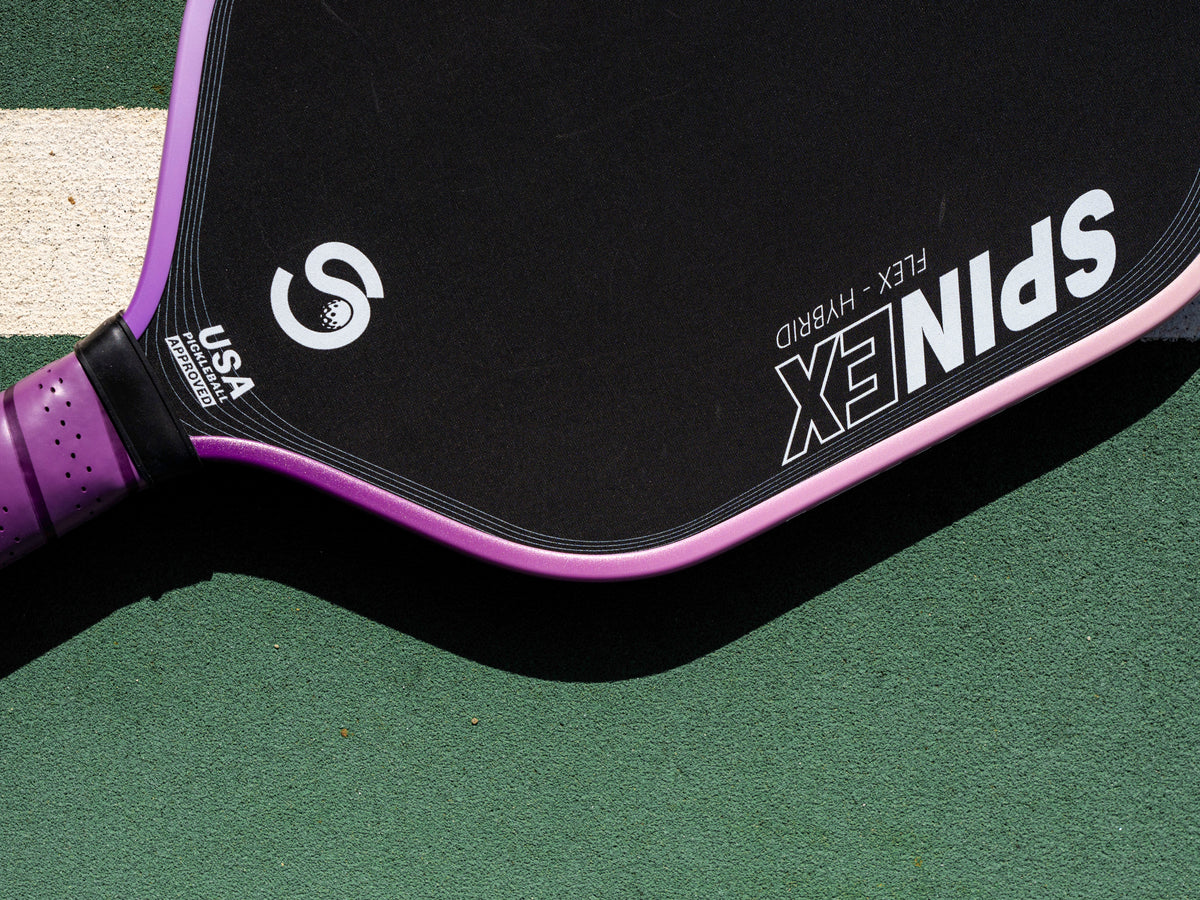
The Spinex FLEX Hybrid ships with a 4.25 inch circumference and a 5.5 inch grip length, which is on the longer side for a pickleball paddle. The longer handle gives you a real two-handed backhand option without crowding the off hand against the throat, but the circumference stays in the middle of the road on purpose. The reason 4.25 inches is the safe default is that it covers most adult hands without forcing players to use an overgrip on day one. In our 30-plus player demo at Sydney Olympic Park Pickleball Courts on 15 February 2026 (DE001), the standard circumference was not the topic of complaints. Common feedback was that the face felt softer than players expected, and 80 percent of testers preferred the 16mm core thickness over thinner demo paddles. Grip size simply was not the variable that drove the choice.
Why grip size matters less in pickleball than in tennis
In tennis, the grip handles a heavier racquet, longer swings, and a lot more wrist load on serves and forehands. A wrong grip size compounds across hours of play and shows up as wrist or elbow strain. In pickleball, the paddle is roughly half the weight, swings are short, and the dink (a soft shot played near the net) is the most common stroke at the recreational level. The wrist is doing far less work. That is why two pickleball players with very different hand sizes can usually share a paddle and both be comfortable.
The advice still matters. It just matters less than the internet implies. If your grip is roughly right, the rest of your paddle setup (weight, balance, and surface) will have a bigger impact on how the paddle feels in your hand than a 0.125 inch difference in circumference.
How to measure your grip size at home
There are two reliable methods. The ruler method is most common online. The index finger test is faster and works better for pickleball, where the grip is short. We recommend doing both.

Method 1: The ruler test (the tennis classic)
Open your dominant hand and hold it flat with fingers extended. Find the bottom horizontal crease of your palm (the one closest to your wrist). Measure from that crease in a straight line up to the tip of your ring finger. That distance in inches is your tennis grip size.
For pickleball, a common adjustment is to subtract about 0.125 inch from the tennis result. If the ruler test gives you 4.375 inches in tennis, try a 4.25 inch pickleball grip. The reasoning is that the shorter pickleball handle changes how the hand sits on the grip, so the same circumference feels slightly thicker in pickleball than in tennis. Treat this as a starting point, not a precise rule, and verify with the finger test below.
Method 2: The index finger test (the one we actually use)
Pick up a paddle in a comfortable forehand grip. With the paddle in your dominant hand, try to fit the index finger of your non-dominant hand between the tips of your fingers and the base of your thumb on the gripping hand.
If your index finger slides in with a small gap on each side, the grip is right.
If it does not fit, the grip is too small.
If there is space around your index finger, the grip is too big.
This test came out of tennis racquet fitting, where grip size has been standardised for decades, and it works even better in pickleball because pickleball grips are short enough that one finger covers the relevant width. For the tennis-side background on why grip size matters, see the USTA guide to racquet and grip sizing.
Pickleball grip size chart by hand measurement
The table below maps hand-to-palm-crease length to pickleball circumference. The "Tennis equivalent" column is provided so you can translate from older tennis racquets you may already own.

| Hand measurement | Pickleball grip circumference | Tennis equivalent | Typical player |
|---|---|---|---|
| Under 6.5 in (under 165 mm) | 4.000 to 4.125 in | 4 1/8 (Grip 1) | Children, juniors, very small adult hands |
| 6.5 to 7.0 in (165 to 178 mm) | 4.125 to 4.25 in | 4 1/4 (Grip 2) | Most adult women, smaller-handed adult men |
| 7.0 to 7.5 in (178 to 190 mm) | 4.25 in (industry standard) | 4 3/8 (Grip 3) | Average adult hand, including FLEX Hybrid default |
| 7.5 to 8.0 in (190 to 203 mm) | 4.25 to 4.375 in | 4 1/2 (Grip 4) | Larger-handed adult men, add one overgrip |
| Over 8.0 in (over 203 mm) | 4.375 to 4.5 in | 4 5/8 (Grip 5) | Very large hands, consider two thin overgrips |
When an overgrip is the right answer (and when it is not)
An overgrip is a thin (about 0.55 to 0.65 mm) wrapped layer that goes on top of the original handle wrap. One overgrip adds roughly 0.0625 inch to circumference. Two thin overgrips add closer to 0.125 inch. Most players underestimate how often a grip problem is actually an overgrip problem.

Use an overgrip when:
- You are between sizes and need to bulk up from 4.25 to 4.3125 inches.
- The paddle slips in a humid Sydney or Brisbane summer.
- You prefer a tackier or softer feel than the original wrap.
- You want to delay handle wear (the overgrip absorbs sweat instead of the original wrap).
Do not use an overgrip to fix a paddle that is genuinely too small for your hand. If the index finger test shows no fit, no amount of overgrip will save it. Once you stack two overgrips on top of an original wrap, the handle starts feeling spongy and lifeless, and your control suffers.
The contrarian view: stop trying to optimise grip size
For 90 percent of recreational pickleball players, getting grip size "right" is a 5 percent improvement at best. The bigger grip-related issues are grip pressure (most people squeeze too hard), grip style (continental versus eastern), and overgrip condition (slick from sweat or worn out). We see this every demo. A player tells us their paddle does not feel right and suspects the grip size; we have them hit ten balls; the grip is almost always fine. What is actually wrong is that they are choking up too high, gripping like a hammer, or holding a 7-month-old overgrip with no texture. Fix those three before changing paddles.

Common mistakes when picking a grip size
Buying tennis size, not pickleball size
If you played tennis at a 4 3/8 grip, do not assume you need a 4 3/8 pickleball grip. The shorter pickleball handle makes the same circumference feel slightly thicker. Start one size down (4.25 inches) and add an overgrip if needed.

Starting too big
You can always add circumference with an overgrip. You cannot remove it. A grip that starts too big forces a stiff, wristy stroke that bleeds touch on dinks. Across five FLEX Hybrid paddles tracked with local club players over five-plus months of three to four sessions per week (LO002), all five paddles remain structurally sound, and one player has now replaced the overgrip four times. That tells us overgrip wear and personal preference, not circumference, is what most players adjust over time.
Ignoring overgrip choice
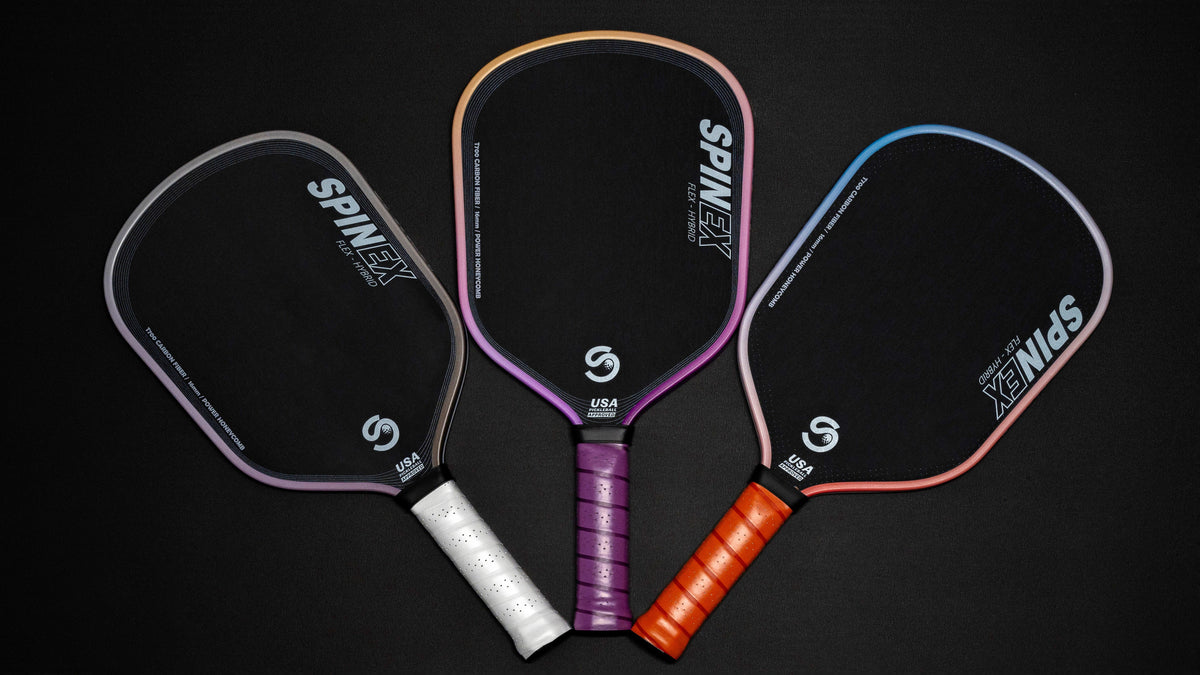
A perforated, tacky overgrip behaves very differently from a smooth, dry one. The same paddle with two different overgrips can feel like two different paddles. Try at least two overgrip styles before deciding your paddle handle is the problem. We sell our own 3-pack in Black, White, Purple, and Orange specifically so you can experiment cheaply.
Treating grip size as static
Hand swelling in heat, glove use in winter, and changing grip style over time all shift the right circumference for you. Re-check every six months.
What is changing in paddle grip design
The pickleball gear market is converging on 4.25 inches as a default. A few years ago 4.125 inches was a common option from US-based premium brands; today, most new mid-priced and premium paddles we see ship at 4.25 inches, with circumference adjustment expected to happen via overgrip. Handle length has also been getting longer, which makes circumference matter even less because the off hand stabilises the paddle on bigger shots. The next likely shift is replaceable cushion grips underneath the overgrip layer, which let serious players adjust circumference without stacking overgrips. We have not adopted that on the FLEX Hybrid yet because a replaceable cushion adds noticeable weight (roughly 4 to 6 grams in similar systems), but we expect it to become more common on premium paddles within the next product cycle or two.


Spinex FLEX Hybrid
Control-focused all-court paddle. 6-layer T700 carbon face, 16mm thermoformed core, USAP-approved.
A$199
Shop the FLEX Hybrid →Frequently Asked Questions
What is the most common pickleball paddle grip size?
4.25 inches in circumference. Most new mid-priced and premium paddles ship at this size, including the Spinex FLEX Hybrid. It works for most adult players from average to slightly larger hands.
How do I know if my pickleball paddle grip is too small?
Run the index finger test. Hold the paddle in your forehand grip and try to slip the index finger of your non-dominant hand between your fingertips and the base of your thumb. If your finger does not fit at all, the grip is too small. You will also notice you have to squeeze hard to keep the paddle from twisting on contact.
Can I add an overgrip to make my pickleball paddle bigger?
Yes. One overgrip adds roughly 0.0625 inch to circumference (about half a grip size). Two thin overgrips add closer to 0.125 inch. Going beyond two starts to deaden the handle feel, so if you need more than that, the paddle handle is genuinely too small for your hand and a different paddle is the better answer.
Is pickleball grip size the same as tennis grip size?
No. Tennis grips run 4.0 to 4.625 inches. Pickleball grips run 4.125 to 4.5 inches, but the shorter handle makes them feel thicker at the same circumference. A tennis player at 4 3/8 (4.375 inches) usually wants a 4.25 inch pickleball grip plus an overgrip if needed.
How often should I replace my overgrip?
Based on our tracking, an overgrip lasts about 22 hours of play on average. In humid Aussie outdoor summer conditions, that drops to about 15 hours. Indoors with steady humidity, it stretches to about 28 hours. For most weekly players, that is once every three to six weeks.
What grip size does the Spinex FLEX Hybrid use?
4.25 inches in circumference with a 5.5 inch handle length. The longer handle accommodates a two-handed backhand cleanly, and the standard circumference suits most adult Australian players. Larger-handed players typically add a single overgrip.
Should women always pick a smaller grip?
Not automatically. Hand size varies more than gender. Use the index finger test, not assumptions. Many adult women fit cleanly on a 4.25 inch grip. Some prefer a 4.125 inch with no overgrip. The test takes ten seconds and is more reliable than any chart.
Does grip size affect spin?
Indirectly. A grip that is the right size lets you relax your hand and snap the wrist more freely, which adds spin. A grip that is too big forces a stiffer wrist, which dampens spin. The paddle face material matters more than the grip for raw spin generation, but a comfortable grip is what lets you actually use the face.
Ready to find a paddle that fits your hand?
Shop pickleball paddles Read the pickleball paddle weight guideIf you want to read more about how a paddle should feel in your hand beyond grip, the Spinex homepage is the best starting point for our full lineup, colourways, and how the FLEX Hybrid is built.
Last reviewed: May 2026. Grip size guidance based on the FLEX Hybrid 4.25 inch production spec, a 30-plus player demo at Sydney Olympic Park Pickleball Courts on 15 February 2026 (DE001), and overgrip durability tracking on three paddles over six weeks of recreational play (TS002). This article is written and published by the Spinex Pickleball team. We design paddles and sell pickleball gear in Australia; where we recommend Spinex products it is because we believe they are a fair fit for the problem being discussed. We aim for honest, useful guidance even when the best answer is a different brand or a cheaper option. Get in touch if you have questions.


Leave a comment
This site is protected by hCaptcha and the hCaptcha Privacy Policy and Terms of Service apply.