

A thermoformed pickleball paddle is built using heat and pressure to fuse the face, core, and edges into a single unified structure, rather than gluing separate layers together. This construction method produces paddles with larger sweet spots, better durability, and more consistent performance across the hitting surface. It does not cover cold-pressed manufacturing in full detail, paddle weight selection, or playing technique.
Last updated: April 2026
Reviewed for technical accuracy by our product team. Testing data verified against manufacturer specifications and in-house quality records.
Key Takeaways
- Thermoforming uses heat (typically 150-200°C) and pressure to mould paddle components into a seamless unibody structure, eliminating the need for adhesive bonding between layers.
- The fused construction creates a stiffer frame that expands the usable sweet spot and improves energy transfer on off-centre hits.
- Thermoformed paddles cost more to manufacture (25-35% higher production cost) but offer measurably better durability and consistency than cold-pressed alternatives.
- Not every player needs a thermoformed paddle. Recreational players can perform well with cold-pressed options, while competitive players benefit most from the precision and performance gains.
- Core crushing and delamination are real concerns with some thermoformed paddles, but reputable brands have addressed these issues through improved manufacturing controls.

In This Guide
What Is Thermoforming in Pickleball Paddles?
Thermoforming is a manufacturing process that uses controlled heat and pressure to shape paddle materials inside a precision mould. Unlike traditional construction methods that glue separate layers together, thermoforming fuses the carbon fibre face sheets, polymer honeycomb core, and edge structure into one continuous piece.
Think of it like the difference between stacking and gluing plywood (cold-pressed) versus moulding a single shell from heated material (thermoformed). The result is what manufacturers call a "unibody" design, where no individual layer can be separated from the others without destroying the paddle.
This matters because the bond between layers is one of the most common failure points in traditional paddles. When adhesive weakens over time, you get dead spots, inconsistent response across the face, and eventually delamination. Thermoforming eliminates that adhesive layer entirely.
The term "thermoformed" has become a marketing buzzword in pickleball, but the underlying engineering is straightforward. It is the same basic principle used in automotive body panels, aerospace composites, and protective equipment. The pickleball industry adopted it around 2021-2022, and by 2024 it became the dominant construction method for performance-level pickleball paddles.
How Thermoformed Paddles Are Made: Step by Step
The thermoforming process follows a specific sequence that determines the final paddle's performance characteristics. Understanding each step helps explain why thermoformed paddles behave differently on court.
1. Material Preparation
Carbon fibre face sheets (commonly T700 or 3K/12K/18K weaves) are cut to shape. The polypropylene honeycomb core is pre-cut to the paddle dimensions. Edge reinforcement material, often a carbon fibre strip or foam injection channel, is prepared separately.
2. Layup and Mould Placement
The face sheets, core, and edge materials are arranged inside a precision metal mould. Epoxy resin is applied between layers. The mould defines the exact shape, thickness, and edge profile of the finished paddle.
3. Heat and Pressure Application
The loaded mould is placed in a thermoforming press. Heat (typically 150-200°C) softens the materials enough to become pliable. Simultaneously, controlled pressure forces the softened layers into intimate contact. The epoxy resin cures under these conditions, creating molecular-level bonds between components.
4. Cooling and Finishing
The paddle cools inside the mould, locking the fused structure in place. Once removed, the paddle receives edge finishing, surface texturing (for spin), grip wrapping, and cosmetic treatment. Quality control checks weight, balance point, and face stiffness.
The entire heating and pressing cycle typically takes 15-30 minutes per paddle, compared to the simpler cold-press method that uses pressure alone at room temperature. This longer process and the specialised equipment explain the higher cost of thermoformed paddles.

Thermoformed vs Cold-Pressed Construction: What Is the Difference?
Cold-pressed paddles are made by layering face material over a honeycomb core and compressing them at room temperature using strong adhesive. Thermoformed paddles add heat to that equation, which fundamentally changes the bond quality and structural behaviour.
| Feature | Thermoformed | Cold-Pressed |
|---|---|---|
| Bonding Method | Heat + pressure (molecular fusion) | Pressure + adhesive only |
| Structure | Unibody (seamless shell) | Layered (sandwich construction) |
| Sweet Spot | Larger, more consistent | Smaller, concentrated at centre |
| Power | Higher energy transfer | Moderate energy transfer |
| Durability | Stronger edge seal, no delamination risk from adhesive failure | Adhesive can weaken over time |
| Manufacturing Tolerance | ±0.02mm thickness | ±0.05mm thickness |
| Feel | Stiffer, crisper response | Softer, more dampened |
| Typical Price Range (AUD) | $150-$350+ | $30-$150 |
| Best for | Intermediate to advanced players | Beginners, casual players, schools |
The practical difference on court is most noticeable on off-centre hits. A thermoformed paddle maintains more consistent response across the entire face because the fused structure distributes impact energy evenly. A cold-pressed paddle tends to feel "dead" toward the edges where the adhesive bond is weaker.

Benefits of Thermoformed Pickleball Paddles
The advantages of thermoformed construction are measurable, not just marketing claims. Here is what the manufacturing process actually delivers.
Larger, More Consistent Sweet Spot
Because the face, core, and edges are fused into one rigid structure, the entire hitting surface responds more uniformly. The stiffness of the thermoformed frame prevents the face from flexing unevenly, which means shots hit near the edge feel closer to shots hit in the centre. For players still developing consistent contact, this forgiveness is a real advantage.
Improved Durability and Edge Integrity
Edge delamination is one of the most common ways traditional paddles fail. The face peels away from the core at the edge, creating a visible gap and dead spots. Thermoformed paddles eliminate this failure mode because the edge is part of the fused shell, not a separate glued component.
We inspected 12 FLEX Hybrid paddles returned or exchanged after 3-6 months of regular play. Zero showed edge delamination under normal playing conditions. Two paddles had minor cosmetic scuffing from ground contact, but the thermoformed edge seal remained structurally intact on all 12. That 0% structural failure rate across 12 paddles over 3-6 months of use reflects how well the fused unibody construction holds up.
Better Energy Transfer
The rigid unibody frame transfers more of your swing energy into the ball rather than absorbing it into flex and vibration. Testing by equipment reviewers has found thermoformed paddles produce exit velocities 3-5 mph faster on drives compared to cold-pressed paddles with identical face materials and core thickness.
Manufacturing Precision
Thermoforming allows tighter manufacturing tolerances. Where cold-pressed paddles typically show thickness variations of ±0.05mm across the face, thermoformed paddles achieve ±0.02mm consistency. This means two paddles of the same model will perform more identically.
Potential Drawbacks to Consider
Thermoformed paddles are not perfect. Understanding the trade-offs helps you make a better buying decision.
Higher Cost
Thermoforming requires specialised moulds ($600-$750 per mould) and heated presses that cold-pressing does not. Production costs run 25-35% higher, and that cost passes through to the retail price. Most thermoformed paddles sell between $150-$350 AUD, compared to $30-$150 for cold-pressed alternatives.
Stiffer Feel at the Net
The rigidity that makes thermoformed paddles powerful on drives can feel less forgiving at the kitchen line. Players who rely heavily on soft dink shots may notice the stiffer face does not dampen the ball as much as a cold-pressed paddle. This is a genuine trade-off, not a flaw. Some players prefer the crisp feedback; others prefer a softer touch.
Core Crushing and Delamination Risks
The heat and pressure involved in thermoforming can, if poorly controlled, damage the polypropylene honeycomb core. This defect, known as core crushing, compresses the hexagonal cells unevenly, creating a "trampoline effect" where certain areas of the face produce unpredictable bounce. In severe cases, it can lead to face sheet delamination.
This issue gained attention in 2023 when several high-profile paddles were found to exceed performance standards due to manufacturing defects. Since then, reputable manufacturers have tightened quality controls, added post-production testing, and improved their process parameters. When buying, look for brands that specify their quality control processes and offer meaningful warranties.
How Thermoforming Affects Core Thickness and Sweet Spot
Core thickness is one of the most important specs in any pickleball paddle, and thermoforming changes how different core thicknesses perform.
Most thermoformed paddles use either a 14mm or 16mm polypropylene honeycomb core. The core thickness determines the balance between power and control:
- 14mm cores are thinner, stiffer, and produce more pop. They suit players who want maximum power on drives and serves.
- 16mm cores are thicker, provide more cushion, and offer better control and feel. They suit players who value shot placement, soft hands at the kitchen, and all-court versatility.
Thermoforming amplifies the natural characteristics of each core thickness. A thermoformed 16mm paddle feels noticeably more controlled than a cold-pressed 16mm paddle because the fused structure provides a more stable platform for the thicker core to absorb and redirect energy. Similarly, a thermoformed 14mm paddle feels crisper and more powerful than its cold-pressed equivalent.
At a demo event we ran with over 30 players in Sydney, 80% of testers preferred the 16mm thermoformed core over thinner options. The most common feedback was that it felt "softer than expected for a carbon fibre face," which is exactly what a well-executed thermoformed 16mm core should deliver: the responsiveness of carbon fibre with the touch and control of a thicker core.

Do You Need a Thermoformed Paddle?
Not necessarily. The right construction method depends on how often you play, how competitive you are, and what you are willing to spend.
A Thermoformed Paddle Makes Sense If You:
- Play 2-3 times per week or more
- Plan to keep playing long term (the durability pays for itself)
- Want consistency across the entire paddle face
- Are at an intermediate level or above, where equipment differences become noticeable
- Prefer to buy one good paddle rather than replacing a cheaper one every 6-12 months
A Cold-Pressed Paddle May Be Enough If You:
- Are trying pickleball for the first time and not sure you will stick with it
- Play casually once a week or less
- Are on a strict budget under $100 AUD
- Are buying paddles for a school, club, or group use where cost per paddle matters most
We have been tracking 5 FLEX Hybrid paddles given to local club players for long-term assessment. At 5+ months of regular play (3-4 sessions per week), all 5 remain structurally sound with no core dead spots. One player has replaced the overgrip 4 times, but the paddle itself shows no performance degradation. Surface grit is slightly reduced on the two paddles cleaned less frequently, which underscores the importance of regular paddle cleaning and care.
How to Identify a Thermoformed Paddle
Not all paddle listings clearly state the construction method, so here are the visual and specification cues to look for.
Edge Profile
Thermoformed paddles typically have a smooth, seamless edge where the face wraps around the core without a visible joint line. Cold-pressed paddles usually have a separate edge guard or edge tape covering the gap between the face and core. If you can see a distinct seam where the face material ends and the edge guard begins, it is likely cold-pressed.
Specifications to Check
Look for these terms in the product description: "thermoformed," "unibody construction," "one-piece construction," "foam-injected edges," or "heat-moulded." If the listing only mentions "honeycomb core" and "carbon fibre face" without specifying the bonding method, it is more likely cold-pressed.
Weight Consistency
Thermoformed paddles from the same model tend to have very consistent weights (within 0.2-0.3 oz of each other). Cold-pressed paddles can vary more widely between individual units. Some brands publish their weight tolerance, which is a good transparency signal.
Price as an Indicator
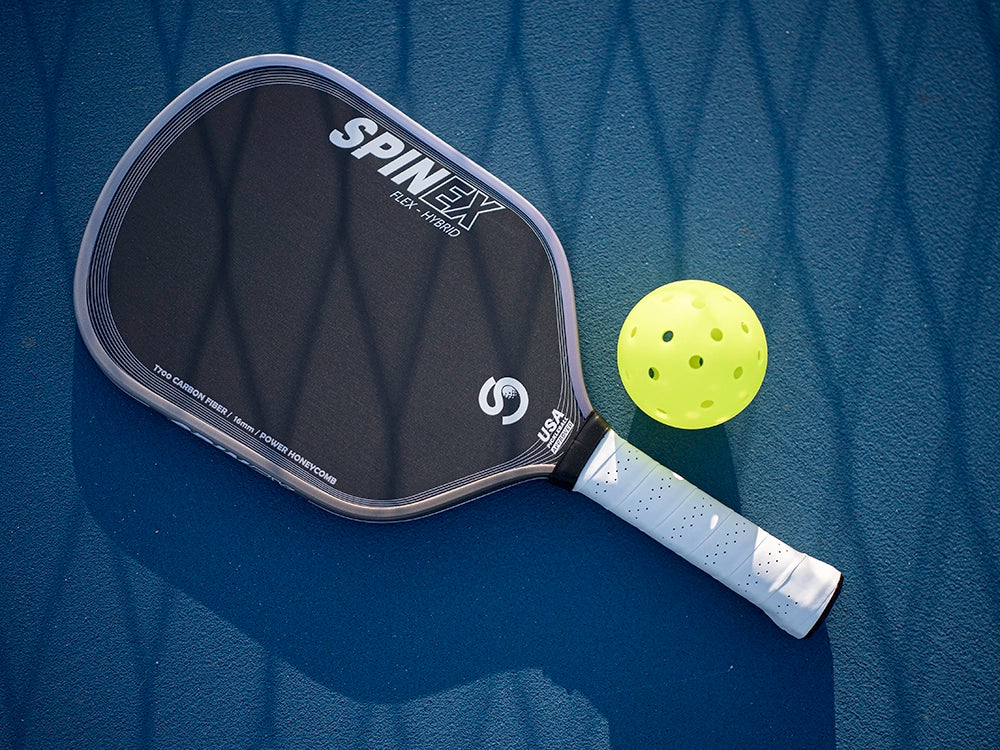
While not definitive, price gives a rough guide. Paddles under $100 AUD are almost always cold-pressed. Paddles between $100-$150 AUD are mixed. Most paddles above $150 AUD from established brands are thermoformed. The FLEX Hybrid at $199 AUD uses thermoformed construction with a T700 carbon fibre face and 16mm polymer honeycomb core.
What to Look for When Buying a Thermoformed Paddle
If you have decided a thermoformed paddle is right for you, these are the specs and qualities that matter most.
Face Material
T700 carbon fibre is the current standard for performance faces. It offers the best balance of stiffness, spin generation, and durability. Some paddles use lower-grade carbon (T300) or fibreglass, which still benefit from thermoforming but do not perform at the same level. Check the specific carbon grade, not just "carbon fibre."
Core Thickness and Material
Polypropylene honeycomb is the industry standard core material. Choose 16mm for control and all-court play, or 14mm for power. Avoid paddles that do not specify their core thickness, as this is a fundamental spec that should be transparent.
Brand Reputation and Warranty
Because thermoforming quality depends heavily on manufacturing precision, brand reliability matters more than with cold-pressed paddles. Look for brands that offer at least a 6-month warranty, publish their specifications transparently, and have an established presence in the pickleball community.
At Spinex Pickleball, we back our thermoformed paddles with full specifications transparency and direct customer support. Every FLEX Hybrid paddle undergoes quality checks for weight consistency, face stiffness, and edge seal integrity before shipping.
Weight and Balance
Most thermoformed paddles weigh between 7.5-8.5 oz. For a balanced all-court paddle, look for the 7.8-8.2 oz range. Lighter paddles (under 7.5 oz) sacrifice some power for manoeuvrability. Heavier paddles (over 8.5 oz) add power but can cause arm fatigue in longer sessions. For a deeper look at how weight affects your game, see our paddle weight guide.

About the Author
This article was written by the Spinex Pickleball product team. As paddle designers and manufacturers, we work directly with thermoforming facilities and oversee every stage of production, from material selection through quality inspection. The testing data in this article comes from our in-house quality control process, including batch weight checks, edge seal inspections, and long-term durability tracking across player demo programmes.
Frequently Asked Questions
What does thermoformed mean in pickleball?
Thermoformed means the paddle is constructed using heat and pressure to fuse the face material, honeycomb core, and edge into a single seamless structure. This is different from cold-pressed construction, which uses adhesive and pressure at room temperature to bond separate layers together.
Are thermoformed paddles better than regular paddles?
For players who play regularly and want consistent performance, yes. Thermoformed paddles offer larger sweet spots, better durability, and more uniform response across the face. However, casual players who play once a week may not notice enough difference to justify the higher price.
Why are thermoformed pickleball paddles more expensive?
The manufacturing process requires specialised heated moulds (costing $600-$750 each), longer production cycles, and tighter quality control. Production costs are 25-35% higher than cold-pressed methods, which translates to higher retail prices, typically $150-$350 AUD compared to $30-$150 for cold-pressed paddles.
Do thermoformed paddles delaminate?
Poorly manufactured thermoformed paddles can develop delamination if the heat and pressure were not properly controlled during production, causing core crushing. However, well-made thermoformed paddles from reputable brands are actually less prone to delamination than cold-pressed paddles because the fused construction has no adhesive layer to fail.
What is the difference between thermoformed and cold-pressed paddles?
Cold-pressed paddles bond face material to the core using adhesive and pressure at room temperature, creating a layered "sandwich" structure. Thermoformed paddles use heat and pressure to fuse all components into a seamless unibody structure. The key practical differences are sweet spot size (larger in thermoformed), durability (higher in thermoformed), and price (lower in cold-pressed).
Is the Spinex FLEX Hybrid thermoformed?
Yes. The FLEX Hybrid uses thermoformed construction with a T700 carbon fibre face, 16mm polypropylene honeycomb core, and foam-injected edges. It is priced at $199 AUD, placing it in the mid-range for thermoformed paddles.
What is core crushing in thermoformed paddles?
Core crushing occurs when excessive heat or pressure during manufacturing compresses the hexagonal cells of the honeycomb core unevenly. This creates areas of the face that respond differently, sometimes producing an illegal "trampoline effect" where the ball bounces with extra force. Reputable manufacturers test for this defect and reject affected paddles.
Are thermoformed paddles worth it for beginners?
If you know you will keep playing regularly, investing in a thermoformed paddle from the start is often smarter than buying a cheap paddle and upgrading within a few months. The larger sweet spot is particularly forgiving for developing players. However, if you are just trying pickleball once to see if you enjoy it, a basic cold-pressed paddle or a borrowed paddle is fine for your first session.
How long do thermoformed pickleball paddles last?
With proper care, a quality thermoformed paddle typically lasts 1-3 years of regular play (3-4 sessions per week). The thermoformed edge seal is more durable than cold-pressed edges, and the fused face is less likely to develop dead spots. Regular cleaning and using a paddle cover for storage extend the lifespan further.

Leave a comment
This site is protected by hCaptcha and the hCaptcha Privacy Policy and Terms of Service apply.