
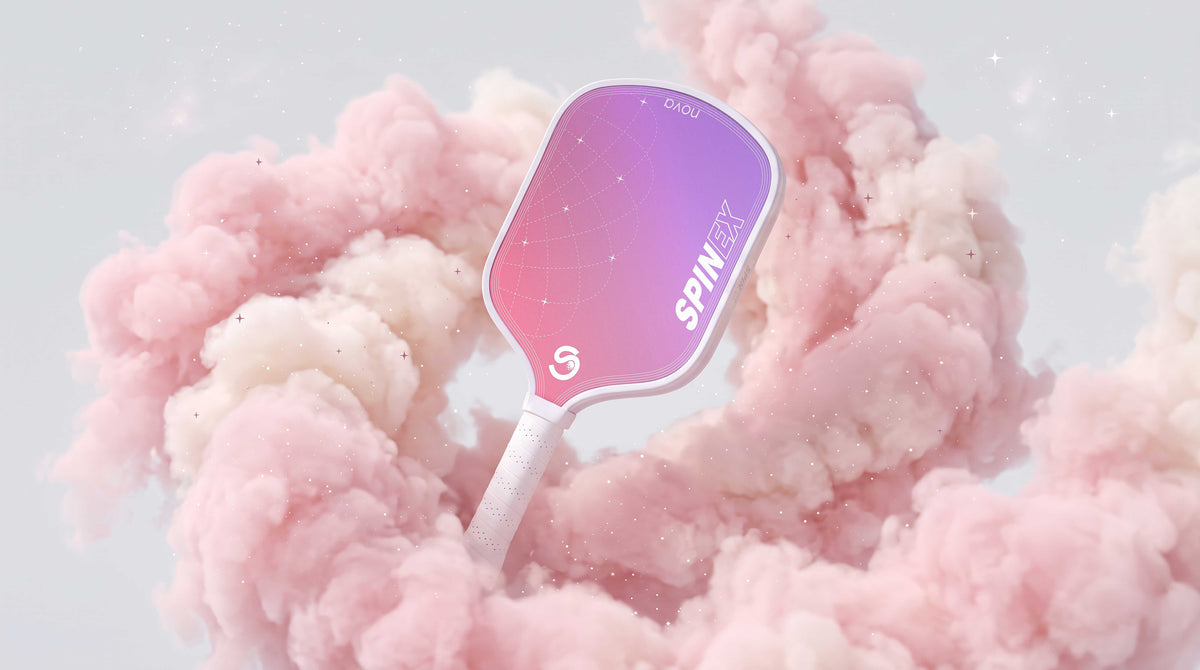
A pickleball paddle is your most important piece of equipment on the court, and choosing the right one comes down to five key factors: weight, core thickness, surface material, grip size, and paddle shape. Paddles in Australia typically range from $30 budget options to $300 or more for premium carbon fibre models, with the sweet spot for most players sitting between $100 and $200.
The problem is that with hundreds of paddle options available, the selection process can feel overwhelming. Core thickness, surface texture, T700 versus T300 carbon, thermoformed versus edge-guard construction. The marketing language alone is enough to make your head spin.
This guide strips the decision down to what actually matters. If you play once a month at a friend's house, you don't need the same paddle as someone training three times a week. And if you're upgrading from a starter paddle, knowing which specs translate to real on-court differences will save you from spending money on features you won't feel.
Key Takeaways- Weight (7.3 to 8.4 oz for most players), core thickness (14mm to 16mm), and surface material are the three specs that make the biggest difference to how a paddle plays.
- Thicker cores (16mm) offer more control and a larger sweet spot, while thinner cores (14mm) generate more power and pop.
- For beginners and intermediate players, a midweight paddle (7.8 to 8.2 oz) with a 16mm core provides the most forgiving, consistent performance.
- Grip size affects comfort and injury prevention more than most players realise. Measure before you buy.
- Spending $100 to $200 gets you into quality carbon fibre territory. Below that, you're usually getting fibreglass. Above that, you're paying for marginal gains.

- Paddle Weight: The Factor You'll Feel Most
- Core Thickness: Control vs Power
- Surface Material: Carbon Fibre, Fibreglass, or Graphite?
- Grip Size: The Most Overlooked Factor
- Paddle Shape: Standard, Elongated, or Wide
- Thermoformed vs Edge Guard Construction
- What to Spend: A Realistic Budget Guide
- Common Mistakes to Avoid
- How to Match a Paddle to Your Playing Style
- Frequently Asked Questions
Paddle Weight: The Factor You'll Feel Most
Paddle weight is the single most noticeable difference between any two paddles. Pick up a 7.2 oz paddle and then an 8.4 oz paddle, and you'll feel the difference immediately, even if every other spec is identical.

Pickleball paddles fall into three weight categories. Lightweight paddles sit below 7.3 oz and suit players who want fast hands at the net and easy manoeuvrability. Midweight paddles range from 7.3 oz to 8.4 oz and offer the best balance of control and power for most players. Heavyweight paddles above 8.4 oz deliver more power on drives and serves but can tire your arm during longer sessions.
For most new and improving players, midweight is the right starting point. A paddle around 7.8 to 8.2 oz gives you enough stability to absorb hard shots without feeling sluggish during quick net exchanges. It's also the weight range where you'll find the widest selection of quality paddles.
One thing worth knowing: a difference of 0.1 oz between two paddles is virtually impossible to feel during play. If you're choosing between a 7.9 oz and an 8.0 oz paddle, pick based on other factors. The weight difference is irrelevant.
If you have a history of tennis elbow or wrist issues, lean toward the lighter end of midweight (7.3 to 7.6 oz). Heavier paddles put more strain on joints over time, and an arm injury will affect your game far more than an extra fraction of an ounce ever could.
Core Thickness: Control vs Power
Core thickness determines how the ball feels when it leaves the paddle face and is one of the most important decisions in the selection process. Most paddles on the market today range from 11mm to 16mm thick.
Thicker cores (14mm to 16mm) compress more on contact, holding the ball on the face slightly longer. This produces a softer feel with more control, a larger effective sweet spot, and better performance on touch shots like dinks, drops, and resets. For players still developing consistency, a thicker core is more forgiving on off-centre hits.
Thinner cores (11mm to 13mm) are stiffer by comparison. The ball leaves the face faster, producing more pop and power. Players who favour a drive-heavy, aggressive style often prefer thinner paddles. But thinner cores also come with a smaller sweet spot and less margin for error.
The majority of paddles sold in 2026 use a polymer honeycomb core, which is lightweight, quiet, and effective. Some newer paddles use foam cores or foam-injected designs for additional vibration dampening and an even softer touch. Polymer honeycomb remains the most proven and widely available option.
For a practical starting point: 16mm suits beginners, control players, and anyone who plays a lot of soft game (kitchen rallies, drops, resets). 14mm suits intermediate to advanced players who want a blend of control and pop. Below 14mm is typically for experienced players with consistent technique who want maximum power.

Surface Material: Carbon Fibre, Fibreglass, or Graphite?
The paddle face is what makes contact with the ball, and its material affects spin, power, and feel. Three surface materials dominate the market.
Carbon fibre is the current standard for mid-range to premium paddles. It's lightweight, stiff, and produces a clean, controlled feel on contact. Most carbon fibre faces use a raw or textured finish that grips the ball well, giving you reliable spin potential. Higher grades of carbon fibre, such as T700 Toray, offer a more refined contact feel compared to lower grades like T300. Carbon fibre paddles typically start around $100 to $120 in Australia.
Fibreglass (composite) faces have a slight flex to them, which creates a trampoline-like effect. The result is more power, especially on drives and smashes. The trade-off is less control and a slightly less predictable ball response compared to carbon fibre. Fibreglass paddles are generally more affordable, sitting in the $40 to $100 range.
Graphite is thin, light, and responsive. It was the premium standard before carbon fibre became widely available. Graphite paddles offer a fast feel but typically less spin texture than modern carbon fibre options.

For most players in 2026, carbon fibre offers the best overall balance of control, spin, and durability. Fibreglass is a solid choice if your budget is under $80 or you specifically want a power-focused paddle. Graphite is less common in new releases and has largely been overtaken by carbon fibre technology. If you want to see how different surface materials compare across real paddles, our best pickleball paddles in Australia guide breaks it down by model.
Grip Size: The Most Overlooked Factor
Grip size affects comfort, control, and long-term joint health. It's also the factor most buyers ignore, which often leads to hand fatigue or elbow problems after a few months of regular play.
Standard pickleball paddle grips range from 4 inches to 4.5 inches in circumference. To find your size, measure from the middle crease of your palm to the tip of your ring finger. That measurement in inches is your approximate grip circumference.
If you're between sizes, go smaller. A grip that's too small can be built up with an overgrip wrap (a $5 fix), but a grip that's too large can't be made smaller without replacing the handle entirely.
A smaller grip also allows more wrist movement, which helps with spin shots. A larger grip provides more stability and reduces wrist fatigue, which may suit players with larger hands or those prone to repetitive strain.
Most paddles sold in Australia ship with a 4.0 to 4.25 inch grip, which fits the majority of adult players. If you're unsure, start with whatever comes standard and add an overgrip if it feels too thin after a few sessions.
Paddle Shape: Standard, Elongated, or Wide
Paddle shape affects reach, sweet spot size, and overall balance. The three main shapes on the market are standard, elongated, and wide body.
Standard shape paddles (roughly 15.5 to 16 inches long and 7.5 to 8 inches wide) offer the most balanced combination of reach and sweet spot size. This is the most popular shape and works well for all playing styles.
Elongated paddles (16.5 inches or longer) provide extra reach, which helps with overhead shots and net coverage. The trade-off is a narrower face and a smaller sweet spot. If your technique is consistent, the extra reach can be an advantage. If you're still working on your accuracy, the smaller sweet spot may cause more mishits.
Wide body paddles have a broader face and a larger sweet spot but sacrifice some reach. They're popular among beginners for the added forgiveness and among doubles players who value consistent contact at the kitchen line.
For most players who are still developing their game, a standard shape is the safest choice. It doesn't force you into a specific playing style and lets you figure out your preferences as your technique improves.
Thermoformed vs Edge Guard Construction
Construction method is a newer factor in paddle selection that has become more relevant since 2024. The two main approaches are thermoformed (unibody) and traditional edge guard construction.

Thermoformed paddles are made by moulding the paddle face and frame together as a single piece using heat and pressure. This creates a rigid, seamless structure with a consistent response across the entire face. The result is a more stable sweet spot, less vibration on off-centre hits, and generally better overall feel. Thermoformed construction has become the standard for paddles above the $120 price point.
Edge guard paddles use a separate strip of material around the paddle perimeter to protect the edges. This has been the standard construction for decades. Edge guard paddles are simpler to manufacture and are typically less expensive. The trade-off is a slightly less rigid structure and the edge guard itself adds a small amount of dead weight around the paddle perimeter.
At the $100 to $200 price range, thermoformed construction offers a noticeable improvement in feel and consistency. It's not a make-or-break feature, but if you're comparing two paddles with similar specs at a similar price, the thermoformed option will usually feel better in hand.
What to Spend: A Realistic Budget Guide
Paddle pricing in Australia breaks down into clear tiers, and knowing what you get at each level helps set realistic expectations.

Under $50: Department store and marketplace paddles. Typically wood or basic fibreglass with plastic cores. Fine for a first try at the sport, but you'll outgrow them quickly if you play regularly. If you're at this stage and just want everything in one box to get started, a pickleball set is the simplest way to begin.
$50 to $100: Entry-level branded paddles. Fibreglass faces with polymer cores. Decent for casual play and learning. You'll get reasonable quality without premium materials or construction.
$100 to $200: The quality sweet spot. This range is where you start seeing T700 carbon fibre, thermoformed construction, 16mm cores, and well-designed handles. For most regular players, this tier offers the best value. You're getting materials and construction that make a genuine, noticeable difference on court.
$200 and above: Premium and professional-tier paddles. Additional refinements in materials, balance, and finish. The performance gap between a $200 paddle and a $300 paddle is much smaller than the gap between a $50 paddle and a $150 paddle.
If you're buying your first serious paddle and plan to play at least once or twice a week, the $100 to $200 range is where your money works hardest. Buying too cheap means you'll replace it within months. Buying at the top end means you're paying for differences you may not yet have the technique to appreciate.
Common Mistakes to Avoid
After helping customers choose our full paddle range, we've seen the same mistakes come up repeatedly.

Copying what someone else uses. Your friend's paddle might be perfect for their game but wrong for yours. Heavier players, faster swingers, and soft-game specialists all benefit from different setups.
Obsessing over tiny weight differences. The difference between 7.9 oz and 8.0 oz is not something you will feel in a game. Focus on the broader weight category (light, mid, or heavy) rather than decimal points.
Choosing power when you need control. New players who buy thin-core, power-focused paddles often struggle with accuracy and consistency. Control comes first. Power is easier to develop through technique than equipment.
Ignoring grip size. A paddle with every perfect spec will still feel wrong if the grip doesn't fit your hand. Measure, or at least try before committing.
Spending too much too soon. If you're three months into pickleball, you're still learning what you like. A $150 paddle will serve you well for a year or more. Save the $300 paddle for when you know exactly what specs suit your game.
How to Match a Paddle to Your Playing Style
If you already have some court time and know your tendencies, you can narrow your choice further.


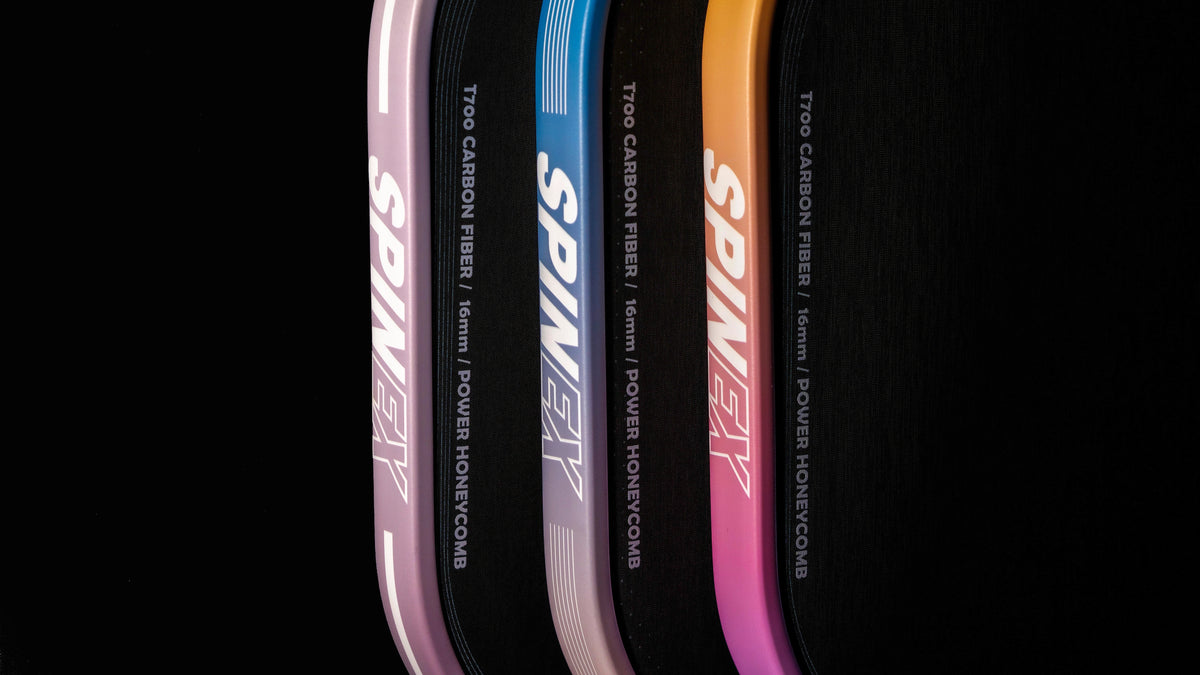
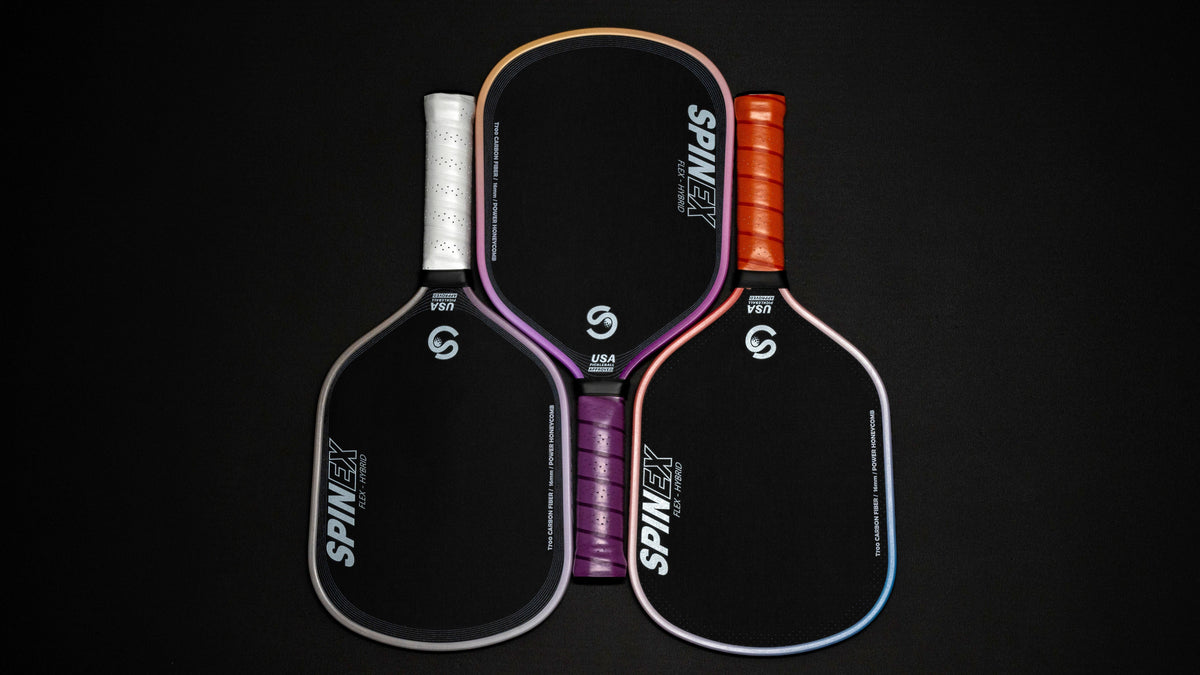
Control and soft game players benefit from a 16mm core, midweight (7.8 to 8.2 oz), and a carbon fibre surface. This combination rewards touch, accuracy, and consistency. The Spinex FLEX Hybrid, for example, uses a 16mm PP honeycomb core with a T700 carbon fibre face designed specifically around controlled spin and a stable sweet spot.
Power and drive players prefer a thinner core (13mm to 14mm), slightly heavier weight, and often a fibreglass or hybrid face for extra pop. This setup suits players who hit hard and rely on pace to win points.
All-court players who want versatility should look for a midweight paddle with a 15mm to 16mm core and a standard shape. This avoids specialisation and gives you reasonable performance across every shot type.
Beginners and improving players should prioritise forgiveness: 16mm core, midweight, standard or wide shape, carbon fibre face. Get the fundamentals right before worrying about optimising for a specific style. Our beginner paddle guide covers this in more detail if you're still narrowing down options.

Spinex NOVA
Built for beginners and social play. T700 carbon face, 16mm thermoformed core, forgiving widebody shape.
A$139
Shop the NOVA →One last thing worth factoring into the decision: a better-built paddle does not just play better on day one, it holds that performance longer. If you are weighing a cheaper option against a properly built one, it helps to know how long a pickleball paddle actually lasts before the face and core start to fade.
Frequently Asked Questions
What is the best core thickness for a beginner?
A 16mm core is the best starting point for most beginners. The thicker core creates a larger sweet spot and softer feel, making it easier to control the ball while you're building consistency. You can always move to a thinner, more power-oriented core later as your technique develops.
Does paddle weight really matter that much?
Yes, but within reason. The difference between lightweight (under 7.3 oz) and heavyweight (over 8.4 oz) is significant and affects power, control, arm fatigue, and hand speed. The difference between 7.9 oz and 8.1 oz is negligible. Choose a weight category, not a specific number.
Is carbon fibre better than fibreglass?
For most players, carbon fibre offers a more controlled, consistent feel with better spin potential. Fibreglass produces more raw power but with less precision. Carbon fibre paddles cost more, typically starting around $100 to $120 in Australia, but the performance difference is noticeable for regular players.
How much should I spend on my first paddle?
If you're committed to playing regularly (once a week or more), $100 to $200 gives you access to quality carbon fibre paddles with good construction. Spending under $50 usually means basic materials you'll outgrow quickly. Spending over $200 gives diminishing returns unless you're an experienced player with specific preferences.
What paddle shape is best for beginners?
A standard shape (roughly 16 inches long, 8 inches wide) offers the most balanced combination of sweet spot size, reach, and manoeuvrability. Elongated paddles sacrifice sweet spot for reach, and wide paddles sacrifice reach for forgiveness. Standard is the versatile middle ground.
Does thermoformed construction make a noticeable difference?
At the same price point, thermoformed paddles generally feel more solid and consistent than edge guard paddles. The unibody construction creates a more rigid, predictable response across the face. It's not the most important factor, but it's a meaningful quality indicator, especially in the $100 to $200 range.
How do I know if my grip size is right?
Measure from the middle crease of your palm to the tip of your ring finger. That measurement in inches is your grip circumference. Most adult players fit a 4.0 to 4.25 inch grip. If you're between sizes, go smaller and add an overgrip. A grip that's too large causes arm strain; too small causes the paddle to twist on contact.
Should I buy a paddle online or try it in person?
Trying paddles in person is always better if you have the option. Many pickleball clubs in Australia lend demo paddles or run trial sessions. Pickleball Australia also offers general guidance on paddle selection for new players. If buying online, look for retailers with good return policies. At minimum, check the weight category, core thickness, and grip size before ordering. These three specs determine most of how the paddle will feel.
What is T700 carbon fibre and why does it matter?
T700 refers to a specific grade of Toray carbon fibre that's stronger and more refined than standard T300 carbon. In paddle terms, T700 produces a cleaner contact feel, better spin control, and improved durability. It's not a marketing gimmick. T700 is measurably stiffer and more consistent than lower-grade carbon. You'll find it in most paddles priced above $120. If paddle approval matters to you, check the USA Pickleball approved paddle list before buying.

Leave a comment
This site is protected by hCaptcha and the hCaptcha Privacy Policy and Terms of Service apply.