If you have spent more than ten minutes researching pickleball paddles online, you have seen the name Joola. They sponsor Ben Johns, the world's top-ranked men's player. They market hard in the United States. Their Perseus and Hyperion paddles are the go-to upgrade for improving American players. And in the last two years, Australian players have started asking the obvious question: should I buy one too?
This is an honest review of what Joola does well and what it gets criticised for. It also asks whether the Australian price makes sense for a recreational or intermediate Aussie player. We have nothing against Joola. We compete with them in a small way. We also respect what they have built. But the most useful answer is rarely the one a marketing page wants you to give.
- Joola Perseus, Hyperion and Magnus are USA Pickleball approved, premium-tier paddles built around T700-class carbon faces and thermoformed polymer cores.
- Australian retail for a Joola Perseus typically sits between A$349 and A$449, roughly 25 to 40 per cent more than US pricing once shipping, GST and importer margin are added.
- Joola was at the centre of a 2024 USA Pickleball reapproval cycle when several Pro IV paddles were temporarily delisted and re-released after a manufacturing change.
- Most recreational and 3.0 to 4.0 level Aussie players will not feel the difference between a top-tier Joola and a well-built A$199 to A$249 carbon paddle bought locally.
- If you already know your style is power-first and you play 4 or more times a week, a Joola Perseus or Hyperion can still be the right buy. For everyone else, the value sits elsewhere.
Quick verdict by player type:
| Your level and play frequency | Is a Joola worth it? | Better-value pick in Australia |
|---|---|---|
| Beginner, first 6 months | No | A forgiving 16mm carbon paddle at A$179 to A$249, bought locally |
| 2.5 to 4.0, social or club, 1 to 4 times a week | Rarely worth the premium | A mid-premium Australian carbon paddle around A$199 |
| 4.0 plus, power-first, tournament, 4 or more times a week | Yes, if you want that exact spec | A Joola Perseus or Magnus, or a comparable Australian flagship |
- Who is Joola, and why are they everywhere?
- The Joola paddle lines, explained
- What Joola actually costs in Australia
- How Joola paddles feel on court
- Problems Australian buyers should know
- The Spinex FLEX Hybrid alternative
- Who should still buy a Joola
- Who should choose a different paddle
- What is changing in the premium market
- Frequently asked questions
Who is Joola, and why are they everywhere in pickleball?
Joola is a German equipment brand founded in 1952, originally famous in international table tennis. They moved into pickleball around 2021 and grew fast on one decision: signing Ben Johns long-term. Ben Johns has held the men's number one ranking in professional pickleball for several years, and his signature Perseus line became the paddle people picture when they hear "premium pickleball".

That sponsorship is the engine. It puts Joola paddles on every televised final, in every highlight reel, in every gear post on Reddit and Instagram. The pitch is simple. If the best player in the world picks this paddle, you should at least consider it.
It works. But it also creates a familiar trap. The same logic sells golf clubs to weekend golfers who would shoot the same score with a A$200 set. The right question is not "is this a good paddle". The right question is whether the difference between a top-tier paddle and a solid mid-premium paddle actually changes your match.
The Joola paddle lines, explained without the jargon
Joola sells five or six families of paddles at any given time. The names rotate, the technology language updates yearly, and it gets confusing fast. Here is the plain version of what most Australian shoppers will actually see.

Perseus (Ben Johns signature, flagship)
The Perseus is the headline paddle. It is currently sold in two main versions, a 14mm core and a 16mm core, both with a thermoformed unibody and a T700-class carbon face. The 14mm is sharper and more powerful. The 16mm is more forgiving and closer to a control profile. Both are around 8.0 to 8.4 ounces and use an elongated shape. International RRP sits at roughly US$280.
Hyperion (the original premium line)
The Hyperion has been Joola's mainstream high-end line for several seasons. It uses a hot-moulded build, a carbon friction face, and a polypropylene honeycomb core. It is generally a touch more all-court than the Perseus. Many Hyperion paddles sit at US$200 to US$260 internationally.
Magnus (Tyson McGuffin signature)
The Magnus line is Joola's other pro endorsement, built around Tyson McGuffin's preferences. It tends to lean even more aggressive than the Perseus, with a slightly heavier swing weight that suits stronger players. Magnus paddles are popular with tournament players who want raw drive speed.
Vision (entry premium)
The Vision is Joola's entry into the premium tier. Carbon face, polymer core, thermoformed, but without the flagship technology updates. Internationally it sits around US$150 to US$180, which makes it Joola's most reasonably priced carbon paddle.
Essentials (budget, non-carbon)
Below the carbon tier, Joola also sells an Essentials range of fibreglass and composite paddles aimed at first-time buyers. These are not the premium carbon models this review focuses on. At that price point you are mostly choosing between a Joola badge and a similarly specced beginner paddle from any number of brands.
What Joola actually costs in Australia
This is the part most Joola review articles skip, and it is the most important part for Aussie shoppers. Joola does not have a strong direct retail presence in Australia. Most stock arrives via specialty pickleball importers, Amazon AU sellers, or grey-market resellers. The pricing reflects that.
Based on listings checked across Australian pickleball retailers (including Pickleball Centre and Backhand Pickleball) and Amazon AU in May 2026, here is the rough landscape. Prices change. Treat these as a guide, not a quote.
| Paddle | US RRP | AU retail (typical) | AU uplift vs US RRP |
|---|---|---|---|
| Joola Perseus IV 14 | US$279 | A$399 to A$449 | ~35 to 40% |
| Joola Perseus IV 16 | US$279 | A$389 to A$439 | ~30 to 40% |
| Joola Hyperion CFS 14 | US$219 | A$329 to A$369 | ~25 to 35% |
| Joola Magnus IV | US$259 | A$369 to A$429 | ~30 to 40% |
| Joola Vision CGS | US$159 | A$229 to A$269 | ~20 to 25% |
| Spinex FLEX Hybrid (for reference) | n/a (AU brand) | A$199 RRP | n/a |

The story is simple. Anything labelled Perseus or Magnus IV crosses the A$400 line easily. By comparison, a solid Australian carbon paddle sits at A$199 to A$259. Most of that gap is AUD/USD currency conversion and the 10 per cent GST, with the rest going to the global supply chain, the pro sponsorship, and importer margin. It does not buy you a noticeably better paddle if you are below 4.0 level.
One pricing warning before you buy: be wary of unusually cheap "Joola" paddles on marketplaces like Temu, AliExpress, or unfamiliar eBay sellers. Counterfeit and grey-import pickleball paddles are increasingly common, and a fake carbon face will neither play nor last like the genuine article. If a current-model Perseus is listed well under A$200, it is almost certainly not a real one.
How Joola paddles feel on court (honest assessment)
Joola Perseus and Hyperion paddles are widely reviewed in the pickleball community, and reviewers tend to agree. The short version: they are very good paddles, and they feel like it. The longer version has more to it.
The Perseus 14 is consistently described as sharp, fast, and slightly hollow in feel. Drives jump off the face. Counters at the kitchen line are quick, and the ball flies. Players who already swing fast and confident tend to love it. Players who are still working on consistent third-shot drops often find it harsh, because off-centre hits fly off the face and sail long.
The Perseus 16 is a different conversation. It is softer, more forgiving on off-centre hits, and easier to reset soft balls into the kitchen. Most improving players would be better served by the 16mm version of any premium paddle, regardless of brand. This is a consistent theme across paddle reviews, and we have written separately about how to choose between control and power paddles.
In February 2026 we ran a demo day at Sydney Olympic Park Pickleball Courts (entry DE001 in our testing log, 30-plus players, mixed club levels). The most common comment from players moving off composite or wood paddles to a premium carbon one was "feels softer than expected for a carbon face". That is true of Joola and true of every modern thermoformed carbon paddle. Premium paddles now use much the same recipe. Blind tested, the gap between a Perseus and a well-built A$199 carbon paddle is much smaller than the price suggests.

The Joola problems Australian buyers should know about
Joola has earned its reputation, but it has also taken some heat. Two things are worth knowing before you spend A$400.

First, the 2024 reapproval cycle. In August 2024, USA Pickleball temporarily delisted several Joola Pro IV models, including some Perseus and Magnus variants, after follow-up testing found them outside the approved spin and surface parameters. Joola updated the manufacturing process and the affected models returned to the approved list later that year. The episode did not affect older Hyperion or Vision lines, but it did damage trust with tournament players who had bought a paddle expecting it to remain compliant.
Second, the Australian after-sales situation. Because most Joola paddles enter Australia through importers rather than a local Joola office, warranty support and exchanges depend on the retailer you bought from. Some Australian sellers offer 6 to 12 month warranties, but only if they choose to. Direct Joola warranty service from the US is slow and shipping a paddle for inspection often costs more than half the price of replacing it. This is not a Joola-specific failure. It applies to most US brands sold here. But it is the reality of owning a premium paddle here.
Spinex FLEX Hybrid as an Australian alternative
We design and sell our own paddle. So this section is the part where you should read with a sceptical eye. We will keep the claims tight and tied to data.

The Spinex FLEX Hybrid has a T700 carbon face, a 16mm thermoformed polymer core, a unibody edge, and USA Pickleball approval. Its hybrid shape sits between an elongated and a standard profile. RRP is A$199. That puts it directly across from the Joola Vision in price, well below the Joola Hyperion, and roughly half the Australian retail of a Joola Perseus.

The honest comparison is not "FLEX Hybrid is better than a Joola Perseus". It is not. The Perseus 14 is a higher-spec paddle for a player who needs that spec. The FLEX Hybrid is built for a different player: an Australian player who wants a forgiving, balanced all-court paddle, plays 1 to 4 times a week, is somewhere between 2.5 and 4.0 level, and does not want to spend A$400 to figure out if they like the sport. Within that window, the FLEX Hybrid does its job well.
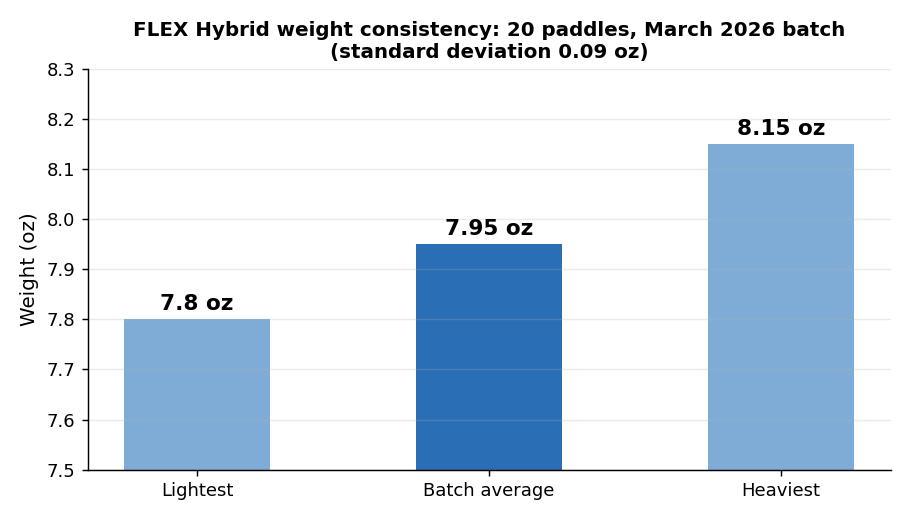
| FLEX Hybrid March 2026 batch (20 paddles) | Result |
|---|---|
| Minimum weight | 7.80 oz |
| Maximum weight | 8.15 oz |
| Average weight | 7.95 oz |
| Standard deviation | 0.09 oz |
| Spread (max minus min) | 0.35 oz |
| USA Pickleball approved | Yes |

For durability, we have been tracking 5 FLEX Hybrid paddles in club hands since November 2025 (entry LO002). At 5 plus months of regular play at 3 to 4 sessions per week, all 5 are still solid, with no edge peeling and no dead spots in the core. One player has replaced the overgrip four times in that window. The grip texture on the two least-cleaned paddles has worn down a little, which is normal for a carbon face and what the paddle cleaner is for.
Who should still buy a Joola
- You are a 4.0 plus player who plays 4 or more times a week and has clearly defined power-first or aggressive counter-driven style.
- You compete in USA Pickleball or PPA-sanctioned tournament events where paddle compliance is checked.
- You have already played multiple A$200 to A$300 paddles and felt the ceiling.
- You strongly prefer an elongated power shape and you can confirm you handle one well.
- You have factored in the Australian price and the warranty situation, and you are comfortable with both.
Who should choose a different paddle
- You play once or twice a week for fun. You will not feel the technology gap.
- You are still in your first 6 months of playing. Any forgiving 16mm carbon paddle in the A$179 to A$249 range will progress your game more than a premium spec you cannot yet use.
- You play with mixed groups and value control, soft hands and ball placement over raw drive speed.
- Your budget for a paddle is A$300 or less. You will get a noticeably better quality-to-price ratio from a locally sold carbon paddle in that range than from any Joola model.
- You want simple Australian after-sales support and a warranty contact you can ring without an international call.
What is changing in the premium paddle market
The next 12 to 24 months will not look like the last 24 months. A few directions to watch.
First, premium paddles are ending up with the same specs: thermoformed, unibody edge, T700-class carbon face, 14mm or 16mm polymer core. Every premium brand uses more or less the same recipe now. The gaps that used to justify a US$280 paddle are shrinking. Expect top-end prices to ease as buyers notice.
Second, USA Pickleball is tightening compliance testing. The 2024 reapproval episode is unlikely to be the last. Buyers should expect more re-tests and short spells off the list from every major brand, not just Joola. Buying from a brand with a stable, established line is lower risk than buying the latest technology release the week it launches.
Third, Australian pickleball is growing fast enough that local brands with local stock, local warranty and local pricing will become the value default. The US-brand-plus-importer model will keep existing at the top end, but the centre of the market is moving home.

Compare a few local options and decide on the pickleball paddle that fits your level, your hand, and your wallet, rather than the one a pro is paid to use.

Spinex FLEX Hybrid
Control-focused all-court paddle. 6-layer T700 carbon face, 16mm thermoformed core, USAP-approved.
A$199
Shop the FLEX Hybrid →Frequently Asked Questions
Are Joola pickleball paddles worth the price in Australia?
For a recreational or 3.0 to 4.0 level player, no. The Australian markup pushes a Joola Perseus to A$399 to A$449, which is roughly twice the price of a comparable Australian carbon paddle. For a 4.0 plus tournament player with a defined power style, a Joola can still be worth it. For most others, the value lives in the A$179 to A$249 range bought locally.
Are expensive pickleball paddles worth it in Australia?
Up to a point. Spending from roughly A$150 to A$250 buys a real jump from a composite or fibreglass paddle to a thermoformed T700 carbon one. Above about A$300 you are mostly paying for pro sponsorships, brand, and import costs rather than on-court performance you can actually feel. Unless you are a 4.0-plus player with a defined power style, the most expensive pickleball paddle is rarely the one that improves your game the most.
What is the difference between Joola Perseus 14 and Perseus 16?
The number refers to the core thickness in millimetres. The 14mm Perseus is faster and more powerful, with a smaller sweet spot. The 16mm Perseus is more forgiving, softer on touch shots, and easier to control on resets and dinks. Improving players are usually better off with the 16mm version, regardless of brand.
Why was Joola delisted by USA Pickleball in 2024?
In August 2024, USA Pickleball temporarily removed several Joola Pro IV models, including some Perseus and Magnus paddles, from the approved list after follow-up testing found them outside approved spin and surface parameters. Joola updated the manufacturing process and the affected models returned to the approved list later that year. Older Hyperion and Vision lines were not affected. Always check the current USA Pickleball Approved Paddle List before buying for tournament play.
Can I get Joola warranty service in Australia?
Joola does not run a dedicated Australian office. Warranty support depends on the retailer you bought from. Some Australian sellers offer a 6 to 12 month warranty at their discretion. Direct Joola warranty handling from the US is slow and shipping a paddle for inspection often costs more than half the replacement price. Factor this into your decision.
Is a Joola Vision worth it as an entry premium paddle?
The Joola Vision is the most reasonably priced carbon paddle in the Joola range. Its Australian retail of A$229 to A$269 puts it close to local premium options at A$199 to A$249. The Vision is a fair paddle, but it is no longer obviously better than well-built Australian alternatives. Buy the Vision for the brand badge. Buy a local equivalent for the value.
Should a beginner buy a Joola paddle?
Almost certainly not. A beginner will not feel the difference between a A$400 Joola Perseus and a A$199 carbon paddle, but they will absolutely feel the difference in the bank account. A forgiving 16mm thermoformed carbon paddle in the A$179 to A$249 range will progress a beginner's game faster than a higher-spec paddle they cannot yet use.
Joola vs Spinex: which is better for Australian players?
Joola Perseus and Hyperion are higher-spec paddles built for power-first tournament play, but they cost A$329 to A$449 in Australia and are not designed around Australian after-sales. Spinex FLEX Hybrid is a control-focused, balanced all-court paddle designed by an Australian team and supported locally, with an RRP of A$199. If you are an aggressive tournament player who needs a Perseus spec, Joola wins on paper. For most Aussie club players, Spinex wins on value and on the paddle profile that actually suits them.
Where can I buy Joola paddles in Australia?
Joola paddles in Australia are mostly sold through specialty pickleball importers (such as Pickleball Centre and Backhand Pickleball), Amazon AU sellers, and some general sports retailers. Stock and pricing vary considerably. Check the Joola model is currently on the USA Pickleball Approved Paddle List before buying if compliance matters to you.
Looking for a premium paddle designed and supported by an Australian team?
Find your browse the paddle range See the FLEX HybridLast reviewed: June 2026. Australian pricing observations were collected across major Australian pickleball retailers and Amazon AU during May 2026 and reflect typical street prices, not promotional pricing. Spec claims are taken from current Joola and USA Pickleball published material. This article is written and published by the Spinex Pickleball team. We design and sell pickleball gear in Australia. Where we recommend Spinex products, it is because we believe they are a fair fit for the player profile discussed. Where Joola or another brand is a better fit, we say so. We review this guide and refresh Joola pricing and USA Pickleball approval details when they materially change. Get in touch if you have questions or spot something that needs a correction.

Leave a comment
This site is protected by hCaptcha and the hCaptcha Privacy Policy and Terms of Service apply.